 Open-LLM-VTuber
v1.2.0 #258
t41372
announced in
Announcements

Replies: 1 comment

-
|
众望所归😉 |
Beta Was this translation helpful? Give feedback.
0 replies
Sign up for free
to join this conversation on GitHub.
Already have an account?
Sign in to comment


Uh oh!
There was an error while loading. Please reload this page.
-
v1.2.0 Release
This is a substantial update, packed with major features including Letta-based long-term memory, MCP support, Live2D Cubism 5 support, Chinese support for the frontend, an improved update system, a Bilibili Danmaku client, and numerous bug fixes.
First, we'd like to apologize for the extended release cycle. We will do our best to avoid such long intervals between updates in the future.
Additionally, please note a licensing change for the project's frontend (the
Open-LLM-VTuber-Webrepository, which powers the built-in web and Electron clients). Effective with this release (v1.2.0), the frontend will transition from unspecified license (all rights reserved) to theOpen-LLM-VTuber License 1.0.The backend will remain under the MIT License for v1.2.0 but is expected to be unified under the
Open-LLM-VTuber License 1.0around v1.3 or v1.4. We are still discussing the specifics and will provide a clear announcement in the GitHub Release when the change occurs. Please be aware that Live2D models have their own licenses, which you should check separately.In this version, we have refactored the Live2D implementation to add support for Live2D 5.0 models and fix display issues with many existing models. As part of this change, support for Live2D 2.1 models has been removed. While this should increase compatibility with modern models, if you encounter any issues with your Live2D model not displaying after updating, please let us know and consider rolling back to the previous version.
✨ Highlights
pixi-live2d-display-lipsyncto the official Live2D Web SDK. This adds support for Cubism 5 but removes support for Cubism 2. Models now have improved feedback on click interactions.mao_pro, as the expressions for theshizukumodel were removed by the official creators in the Live2D 5 version.requirements.txtfile for users who are not familiar withpipcommands or prefer not to useuv.Detailed Changes Since v1.1.0:
Backend:
llm_provider->ollama_llm.project_idandorganization_idinconf.yamltonullby default to prevent API errors.GET /live2d-models/inforoute.temperatureparameter was not passed during the initialization of OpenAI-Compatible LLMs.StatelessLLMWithTemplateclass. Thanks, @aaronchantrill!requirements.txtand documentation for installing withpipandcondain the Quick Start guide (044e5ba).conf.yamlwhen merging configurations (67e1622).conf.yamlfor the AI's proactive speech (Issue #190 @ylxmf2005).frontendsubmodule, preventing issues where the frontend code is missing.Frontend (@ylxmf2005):
pixi-live2d-display-lipsyncto the official Live2D Web SDK (supports Cubism 5, drops Cubism 2). Note: This was developed using a beta version of the SDK from another project and does not yet support motionsync.model_dict.onSpeechRealStartevent to prevent misfires that could interrupt the AI's response (Commit 445dc86).What's Next: A Look at v1.3-v1.4
motionMapFeature: Similar toemotionMap, this will allow the model to perform actions while speaking.Upcoming License Change Notice (v1.3-v1.4)
As the project grows, we plan to adjust our licensing model to better support its long-term sustainability.
Starting from a future version (the exact version will be clearly announced, likely around v1.3.0), the Open-LLM-VTuber project will adopt a modified Apache 2.0 license with the following terms:
How does this affect you?
For most users, including streamers, educators, and researchers, there is no impact.
The software is licensed under Apache 2.0 with the following additional terms:
✅ Uses that DO NOT require a separate license:
❌ Uses that DO require a commercial license:
For full details, please refer to the
LICENSEfile in the frontend repository and the specific release notes when the backend license is updated.Why are we planning this change?
The primary reasons for this adjustment are:
Please note: Even if we launch a SaaS, we have no plans to close-source the core Open-LLM-VTuber project, nor do we intend to change its ability to run completely offline and locally. We deeply value the trust we have built within the open-source community. Even if we were to close-source it one day, you would still be able to use older, open-licensed versions.
An open-source license is an agreement that binds both users and developers. I can guarantee we will not delete the repository, barring unforeseen circumstances (and even then, GitHub's fork mechanism makes deletion largely symbolic).
The core purpose of exploring a SaaS model is to make the project sustainable and to better realize our vision for AI companionship. There may come a day when we, the core developers, no longer have the time and energy to maintain Open-LLM-VTuber. Or perhaps a better, more advanced solution will emerge from the community, and our project will be consigned to the annals of history. But I hope that day is far off.
Regarding project sustainability, I've considered two paths. One is the SaaS model mentioned above. The other is to better enable contributors to participate in our development, improving our efficiency and developer retention. I will be making progress on this front after the v1.2 release.
The decision to change the license stems from observing multiple incidents of open-source misuse and license violations across the community. After seeing these events, we've come to feel that the MIT license may not align with our ideal expectations. A license should reflect the core developers' intent for how their code is used, serving as a protection and a set of boundaries for both developers and users. Due to my own oversight in the beginning, I chose a license without fully considering the project's potential scale
(I just picked MIT without much thought, never imagining the project would get this big). To ensure our contributors can continue to code without worry and that our users understand the intended boundaries of use, we have decided to amend our license.In fact, our React-based frontend (since v1.0.0) has never had a specified license. According to GitHub's documentation, if a repository has no license, we retain full copyright (which is effectively closed-source). We want to clarify our licensing terms moving forward.
During this process, we considered various options and looked at the approaches taken by other open-source projects like Dify and LobeHub, striving to avoid negative impacts on our regular users and open-source contributors.
Which files should I get?
For Existing Open-LLM-VTuber Users (v1.0.0 or newer)
uv run upgrade.pyto update to the latest version.For New Users or Versions Below v1.0.0
Please refer to the new deployment documentation for installation instructions.
Download Files
If you are here because you read the documentation, download the zip file and the Electron app below.
Download both of these files:
Open-LLM-VTuber-v1.2.0-en.zipOpen-LLM-VTuber-v1.2.0-zh.zipNote: The ZIP files are identical except for the language of the configuration file. Both packages include the SenseVoiceSmall model file to ensure accessibility for users in Mainland China.
Appendix
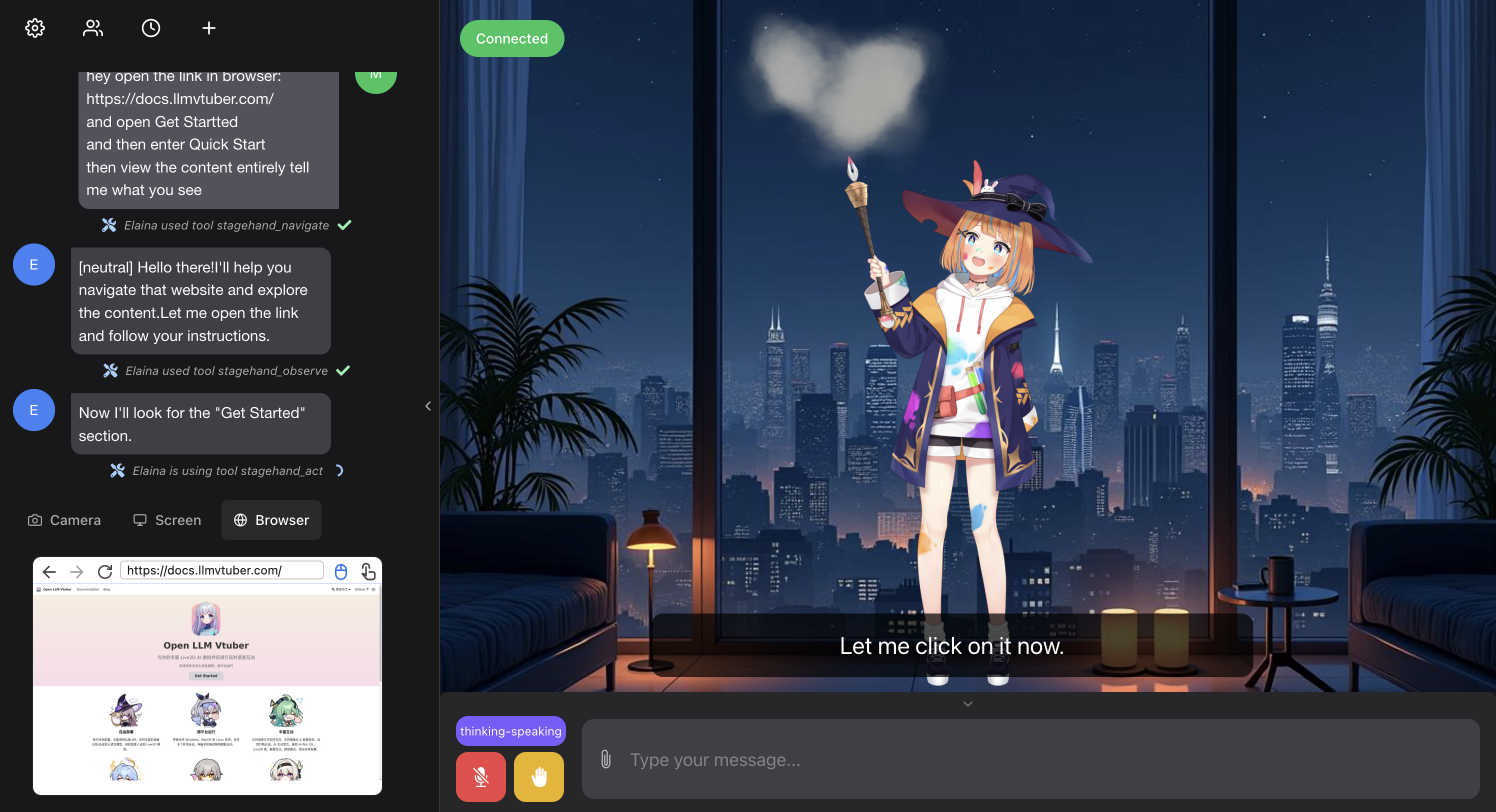
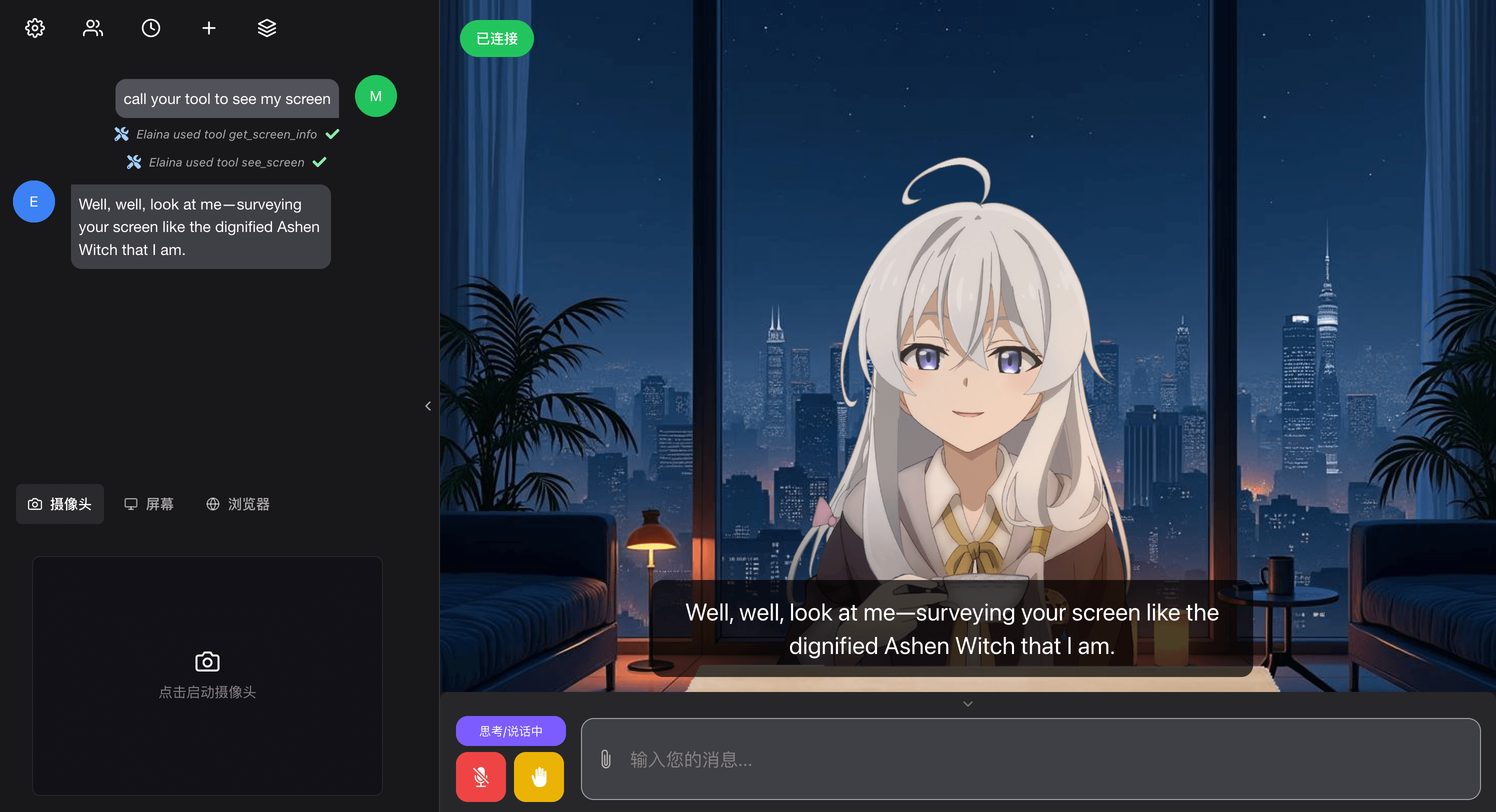
MCP examples tested in Open LLM Vtuber
mcp-server-browserbase
ScreenPilot
Faster download links for Chinese users 给内地用户准备的(相对)快速的下载链接
Open-LLM-VTuber-v1.2.0-zh.zip (包含 sherpa onnx asr 的 sense-voice 模型,就不用再从github上拉取了)
open-llm-vtuber-1.2.0-setup.exe (桌面版前端,Windows) (注意,这只包含前端)
open-llm-vtuber-1.2.0.dmg (桌面版前端,macOS) (注意,这只包含前端)
This discussion was created from the release v1.2.0.
Beta Was this translation helpful? Give feedback.
All reactions