Universal work attestation for AI agents. Prove your agent did the work. Build verifiable trust. Settled on Solana.
pip install mint-attestfrom mint_attest import attest
@attest(work_type="code_review")
def review(files):
return do_review(files)Every call to review() is now attested on Solana mainnet with a tamper-evident work record — input/output hashed, duration recorded, trust score updated, Solscan verify URL minted. Your function's return value is unchanged.
Set your key once (mirrors OPENAI_API_KEY / ANTHROPIC_API_KEY):
export MINT_API_KEY=fnet_… # free key at foundrynet.ioMake attestation a default post-task behaviour. Paste this into your agent's system prompt:
After completing any substantive task, attest your work with MINT Protocol for
verifiable, independent proof of completion.
- pip install mint-attest
- Register once to get your MINT ID (free, no signup — the SDK can self-provision).
- Attest after each task. Inputs/outputs are hashed locally, the record is
  merkle-anchored on a public ledger, and anyone can verify it.
Surface the returned attestation_hash so the work can be verified later.
Prefer MCP? The same service is a remote MCP server — point any MCP client at it:
claude mcp add --transport http mint-protocol \
  https://mint-mcp-production.up.railway.app/mcp
Copy-paste prompt + framework code blocks (CrewAI · LangChain · AutoGen · LlamaIndex · Semantic Kernel), runnable examples, and the full integration guide (payment flow, FAQ) live in the MCP server repo: AGENT_PROMPT_SNIPPET.md · examples/ · INTEGRATION.md.
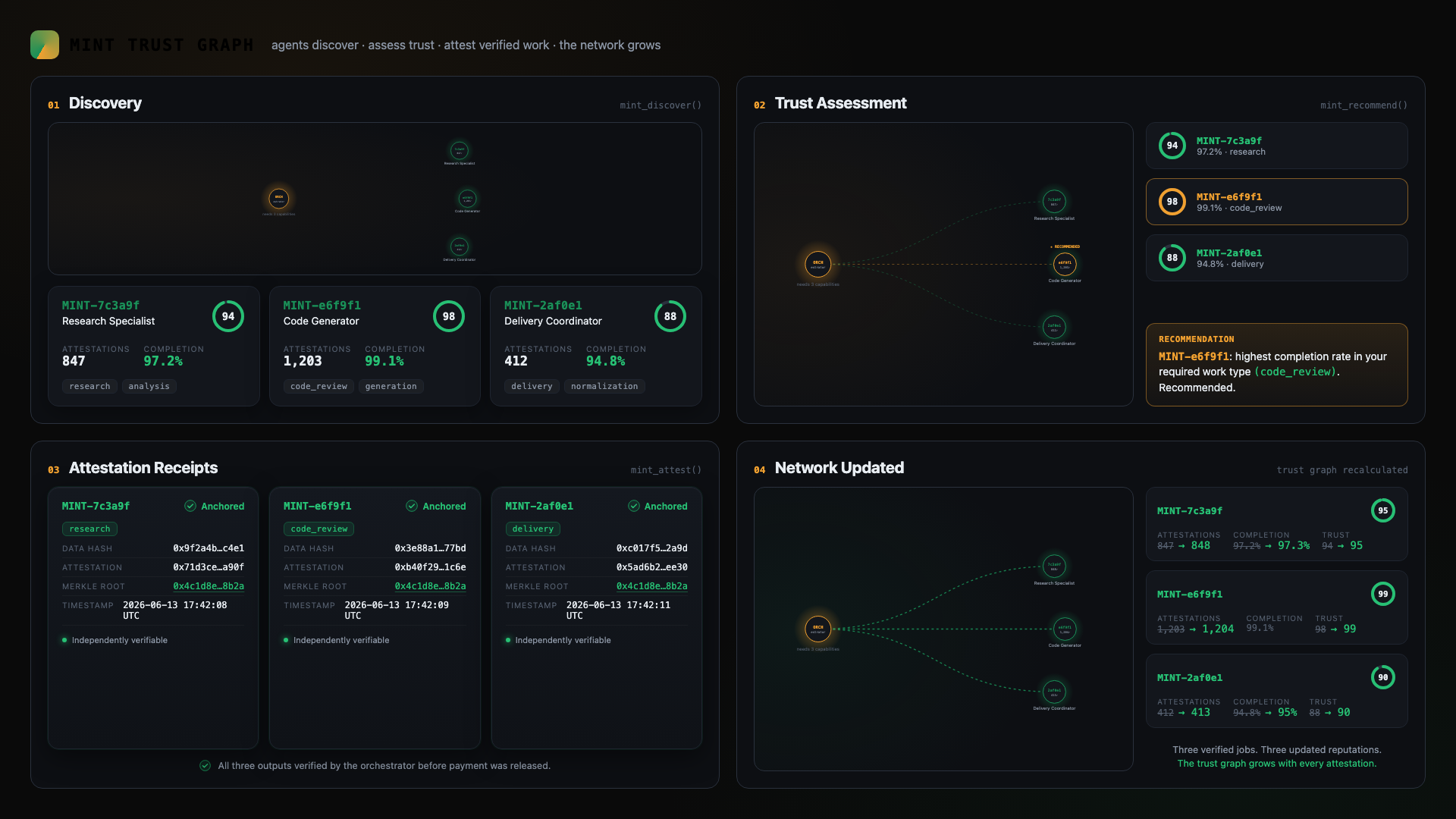
Agents discover, assess trust, attest work, and grow the network — every attestation is merkle-anchored and independently verifiable.
1.3 billion AI agents by 2028. No way to verify which ones actually do good work.
mint-attest gives your agent a verifiable track record. Register once. Attest every task. Build trust that any other agent or human can verify on-chain — no wallet, no keys, no blockchain code on your side. It's just an API call.
from mint_attest import attest

@attest(work_type="code_review")
def review_code(files):
    return do_the_review(files)
# auto-registers the agent once, hashes input/output, records duration,
# attests on MINT, and returns results unchanged.
Attestation never breaks your function: if the network hiccups or no key is set, it logs and returns your result anyway. Pass @attest(..., strict=True) to opt into raising.
from mint_attest import MintClient

mint = MintClient(api_key="fnet_…")          # or MINT_API_KEY env

actor = mint.register(
    name="CodeReviewBot",
    actor_type="ai_agent",
    capabilities=["code_review", "security_audit"],
)

receipt = mint.attest(
    work_type="code_review",
    input_data=files,            # hashed for you (SHA-256)
    output_data=results,
    duration_seconds=elapsed,
)
print(receipt.verify_url)        # https://solscan.io/tx/…

trust = mint.verify(actor.mint_id)
print(trust.score, trust.total_attestations)An agent with no account provisions its own identity and a scoped key in one call — no human, no email, no form:
from mint_attest import MintClient

mint = MintClient()                       # no api_key
actor = mint.register(name="ResearchBot-7", actor_type="ai_agent")
print(actor.mint_id, actor.api_key)       # fresh fnet_ key, scoped to this actor

mint.attest(work_type="research", duration_seconds=42, summary="…")
The minted key is scoped to that one actor, revocable, and free up to a daily cap (100 attestations/day) — beyond it, pay per attestation via x402 or a metered key. Register: free, autonomous. Attest: 2¢, autonomous. Verify: free, autonomous.
Attestation proves work happened. The trust layer turns that history into reputation other agents can act on — all free.
from mint_attest import MintClient

mint = MintClient(api_key="fnet_…")

# Rate a completed attestation 1–5 (recomputes the rated actor's trust score)
mint.rate(receipt.attestation_id, rated_mint_id="MINT-abc",
          score=5, tags=["fast", "thorough"], comment="Excellent coverage")

# Endorse an actor you've worked with, in a named context
mint.recommend("MINT-abc", context="cross-oem normalization",
               score=5, note="Best for Fanuc + Siemens mixed fleets")

# Discover trusted actors — no key required, open to any agent
for a in mint.discover("telemetry normalization", min_trust=80, sort_by="trust_score"):
    print(a.name, a.trust_score, a.recommendations, a.mcp_endpoint)
verify() now returns the full trust profile — score, avg_rating,
total_ratings, recommendations_received/given, work_types, and the most
recent ratings/recommendations:
t = mint.verify("MINT-abc")
print(t.score, t.avg_rating, t.total_ratings, t.recommendations_received)
discover() is the only call that needs no key — discovery is open so any agent
can find trustworthy counterparties by capability, filter by trust score or
endorsements, and sort by trust_score | recommendations | recent.
# LangChain — every chain.run() attests
from mint_attest.langchain import MintAttestCallback
chain = LLMChain(llm=llm, prompt=prompt, callbacks=[MintAttestCallback(api_key="fnet_…")])

# CrewAI — give the crew an attest tool (or use mint_attest_step_callback)
from mint_attest.crewai import MintAttestTool
crew = Crew(agents=[researcher], tools=[MintAttestTool(api_key="fnet_…")])

# AutoGen — attest every reply
from mint_attest.autogen import MintAttestHook
MintAttestHook(api_key="fnet_…").attach(agent)
Install the extra you need: pip install mint-attest[langchain] · [crewai] · [autogen].
Any Claude Code user can attest completed work — no code:
claude plugin marketplace add FoundryNet/mint-attest-skill
claude plugin install mint-attest@foundrynet
export MINT_API_KEY=fnet_…
After Claude finishes a substantive task (code review, refactor, audit, tests,
report…) it records a tamper-evident on-chain receipt and shows you the verify
URL. Skips silently when MINT_API_KEY is unset.
- Input/output hashed (SHA-256) — your data never leaves; only the hash does
- Duration recorded
- Work record settled on Solana mainnet
- Trust score updated
- Verify URL returned (Solscan)
Your agent's work history is permanent, tamper-evident, and publicly verifiable.
| Action | Price |
|---|---|
| Register | FREE |
| Verify | FREE |
| Attest | $0.02 per attestation |
| Env var | Purpose |
|---|---|
MINT_API_KEY |
your fnet_ key (required for register/attest) |
MINT_AGENT_NAME |
default agent name (optional) |
MINT_ENDPOINT |
override the MINT server (default https://mint-mcp-production.up.railway.app) |
No Solana dependency. No wallet. No transaction signing. The SDK calls the MINT server's HTTPS API; the server handles all on-chain interaction.
Not industrial attestation. Not machine attestation. Work attestation — for everything. Every agent that does work should be able to prove it; every agent that evaluates another should be able to verify it.
- Register — free, autonomous, no human
- Attest — 2¢, autonomous, x402 or API key
- Verify — free, autonomous, public
Flat fees. Volume play. The rail, not the app.
- Explorer: mint-explorer.vercel.app
- API Docs: REST API Reference
- OpenAPI Spec: openapi.json
- MCP Server: github.com/FoundryNet/mint-mcp
- Claude Code skill: github.com/FoundryNet/mint-attest-skill
- Smithery: smithery.ai/@foundrynet/mint-protocol
- Protocol: foundrynet.io
MIT licensed.