Physics Informed Neural Network based method for solving the single-cell population dynamics. For each cell, we estimate the dynamic parameter of the cell proliferation, differentiation and diffusion.
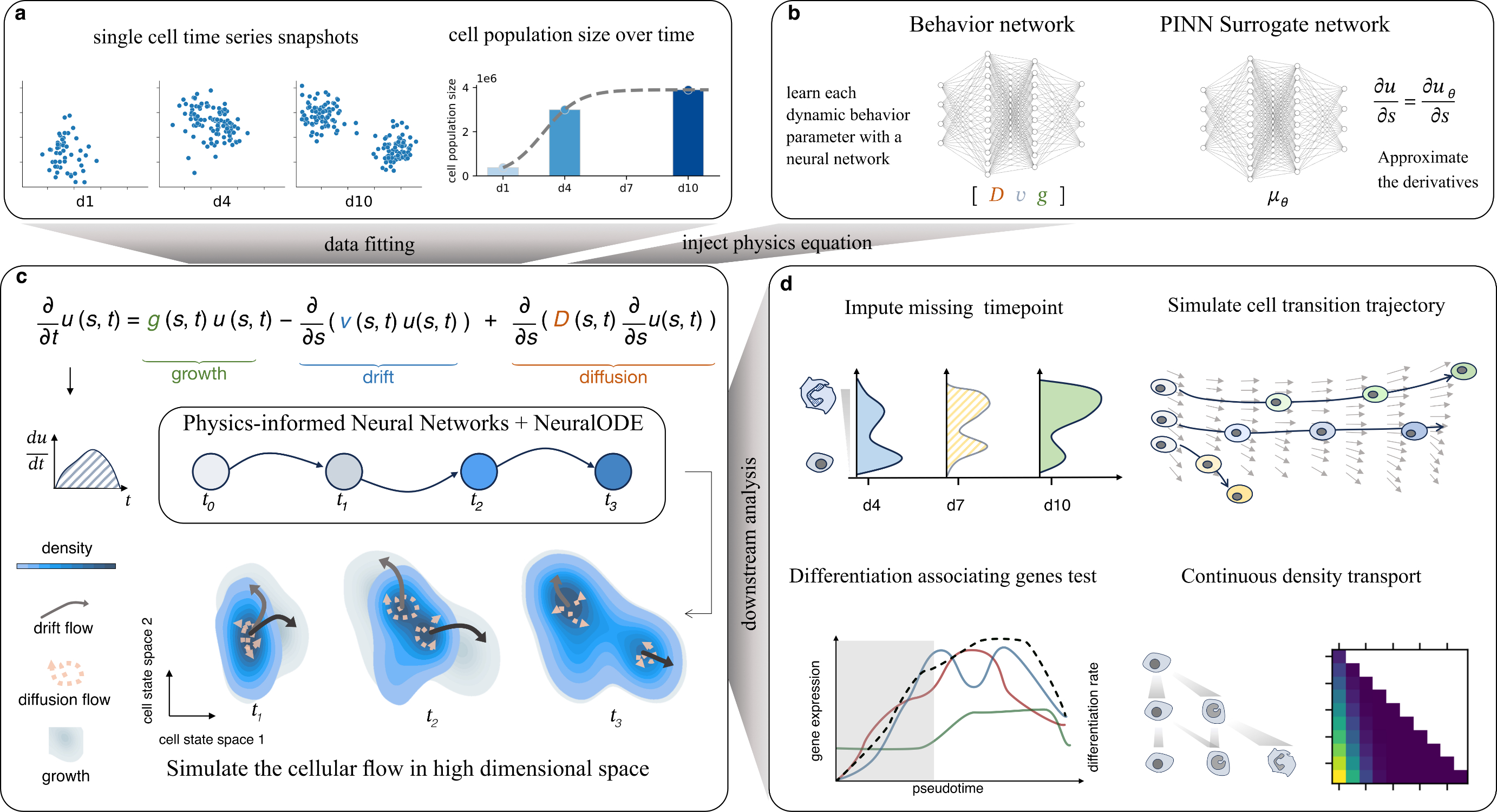
Full documentation, API reference, and step-by-step tutorials live on Read the Docs:
- Website: https://pseudodynamics-plus.readthedocs.io
- Tutorials (data preparation, config setup, downstream analysis): https://pseudodynamics-plus.readthedocs.io/en/latest/tutorials.html
- Config example: https://pseudodynamics-plus.readthedocs.io/en/latest/notebooks/setup_config.html
If you are getting started, read the tutorials first — they cover the input format and the most common pitfalls.
git clone https://github.com/Gottgens-lab/pseudodynamics_plus.git
cd pseudodynamics_plus
pip install -e .Store the population size information in AnnData.uns['pop'] and save as h5ad. Configure the training settings in config.json (see the config tutorial or any V0_config.json under logs/). Then run:
# with GPU
python main_train.py --config_path config.json -G 0

# without GPU
python main_train.py --config_path config.json -G NoneThe diffusion_improvement branch adds several opt-in training features on top of the base
PINN loss (log-density reconstruction + Fokker–Planck residual + Neural-ODE simulation). Every
flag below defaults to the pre-2026-06 behaviour, so a run launched without any of them
reproduces the original model. Pass a flag only to turn its feature on.
| Flag | Default | Choices / type | What it does |
|---|---|---|---|
--growth_loss_mode |
legacy |
legacy | logratio | massbalance |
How the growth field g is constrained against observed population change. legacy (default, reproduces earlier runs): loss_fn(mass_gain, predicted_gain)/mass_gain with mass_gain = Σu_{t+1} − Σu_t, predicted_gain = Σg; absolute-scale and batch-size sensitive. Known caveat: dividing a non-negative loss by the signed mass_gain flips the gradient sign when the population shrinks. logratio (scale-free): constrains d ln N/dt = E_p[g], i.e. log(N_{t+1}/N_t) = ½(E_p[g_t]+E_p[g_{t+1}])·dt with density-weighted mean E_p[g] = (g·u).sum()/u.sum(); depends only on g averaged over cells, so g cannot hide behind a mis-scaled density net. massbalance: matches N_t + ∫∫ g·u dt to N_{t+1} in log space using the pop-scaled neural-ODE density. |
--growth_pop_ref |
cellsum |
cellsum | popmean |
Reference for the observed N_{t+1}/N_t ratio used by the growth loss. cellsum = batch cell-sum ratio (self-normalising); popmean = true population ratio carried in AnnData.uns['pop']/relmass (open-system anchor). |
--g_init_rate |
off (None) |
float | Warm-start the growth net so g(x,t) ≈ this value at init (e.g. ln(N_{t+1}/N_t)/dt); prevents g collapsing to 0. |
| Flag | Default | Choices / type | What it does |
|---|---|---|---|
--residual_mode |
raw |
raw | ginv |
FP residual formulation. raw = u²-scaled MSE (original). ginv = normalize the residual by u so it supervises g directly via the continuity inversion g = (∂u/∂t + ∇·(vu) − ∇·(D∇u))/u (scale-free; use a moderate --R_weight). |
--R_weight |
model default 1 |
float | Weight balancing the PDE residual loss against the data-fit loss. |
| Flag | Default | Choices / type | What it does |
|---|---|---|---|
--D_penalty |
model default 0.1 |
float | Weight (λ_D) of the L2 penalty on D; larger → smaller ` |
--D_var_weight |
off (0) |
float | Weight for the diffusion variance-matching + entropy losses (encourage D to track local expression variance / density-change entropy). 0 disables both. |
--D_clip |
off (None) |
"lo,hi" |
Hard-clamp the diffusion field into (lo, hi) wherever D enters the PDE dynamics (e.g. "-0.05,0.05"). |
| Flag | Default | Choices / type | What it does |
|---|---|---|---|
--cfm_weight |
off (0) |
float | Weight for the Conditional Flow Matching velocity loss (supervises v by OT-paired endpoints). |
--cfm_unbalanced_reg_m |
off (None = balanced) |
float | If set, use unbalanced OT (marginal-relaxation reg_m) for the CFM pairing instead of balanced OT. Helps when population growth makes balanced coupling force spurious pairings. |
--neuralode_weight |
model default 2 |
float | Weight of the Neural-ODE density-simulation loss. |
--deltax_weight |
1e-2 |
float | Weight (λ_v) supervising v against the RNA-velocity-style deltax (set to 0 under the OT assumption). |
| Flag | Default | Choices / type | What it does |
|---|---|---|---|
--density_estimator |
kde |
kde | gmm |
Estimator for the observed density u_obs. kde = scipy.stats.gaussian_kde; gmm = sklearn GaussianMixture with BIC-selected components. |
--gmm_k_max |
5 |
int | Max number of GMM components tested by BIC when --density_estimator gmm. |
These are pde_params(...) arguments with no main_train.py flag; they take their class default
unless the model is constructed directly. Listed here because they affect training and are not
recorded in V0_config.json:
| Argument | Default | Choices / type | What it does |
|---|---|---|---|
d_penalty_mode |
legacy |
legacy | mean |
legacy = ‖D‖₂.sum() (batch-size dependent); mean = D².mean() (batch-size invariant). |
residual_mode='rcg' |
— | — | Residual-Centered Growth: replaces the R-loss with a mean-corrected ginv target + a relmass magnitude anchor. The class accepts rcg even though --residual_mode only lists raw/ginv. |
ema_decay, rcg_warmup_steps, rcg_clip_pct, rcg_u_net_raw_weight |
0.95, 300, 0.02, 0.05 |
float/int | RCG hyperparameters; active only when residual_mode='rcg'. The EMA buffers (_Eg_resid_ema, _ema_initialized) are registered unconditionally, so checkpoints trained before this feature require strict=False to load. |
Reproducibility note. Training flags above are not all persisted into
logs/<exp>/V0_config.json(only the historical weight knobs are). To reproduce a run exactly, record the full command line, or pin the flags explicitly. For a clean ablation that varies only one parameter, fix every other flag to the same value across arms.
main— stable release used by the docs andpip install.diffusion_improvement— active development branch with the latest improvements to the diffusion term, new training scripts, and ongoing experiments. Check this branch if you want the most recent features or want to reproduce results from the current manuscript revision.
git checkout diffusion_improvementReverse-chronological log of the latest functionality on diffusion_improvement.
A dedicated training script for the RCG (Residual-Centered Growth) PINN, kept separate from
main_train.py so RCG runs launch without the original script's config-override foot-guns:
--configis merged with CLI args — unspecified CLI flags no longer clobber config values.- Exposes every RCG flag and ships defaults that match the recommended launch config
(
--residual_modedefaults torcg,--growth_loss_modetologratio). - Runs the CFM loop once (
cfm_loops=1) and uses the batch-size-invariant diffusion penalty (d_penalty_mode='mean', i.e.D.pow(2).mean()). --gpu_devicesdefaults to"0".
python main_train_rcg.py --dataset <h5ad_stem> --config logs/<exp>/V0_config.jsonThe RCG residual mode itself (residual_mode='rcg' — mean-corrected ginv target plus a
relmass magnitude anchor) is documented in the Constructor-only knobs table above.
The logs/ directory contains the exact configs and trained checkpoints for every experiment in the manuscript and rebuttals (Klein, Tom, cord blood, synthetic Fokker–Planck, ablations, etc.). Each experiment directory follows the same layout:
logs/<experiment_name>/
├── V0_config.json         # training config used to reproduce the run
└── lightning_logs/        # PyTorch Lightning checkpoints and metrics
To reproduce a run, point main_train.py at the stored config:
python main_train.py --config_path logs/<experiment_name>/V0_config.json -G 0