Built by OptimNow. Covers cloud financial management across AWS, Azure, GCP, AI inference costs, GenAI capacity planning, SaaS asset management, and tagging governance - grounded in enterprise delivery experience.





| Tool | One-step install |
|---|---|
 |
At the Claude Code prompt: /plugin marketplace add https://github.com/OptimNow/cloud-finops-skills.git then /plugin install cloud-finops@optimnow |
 |
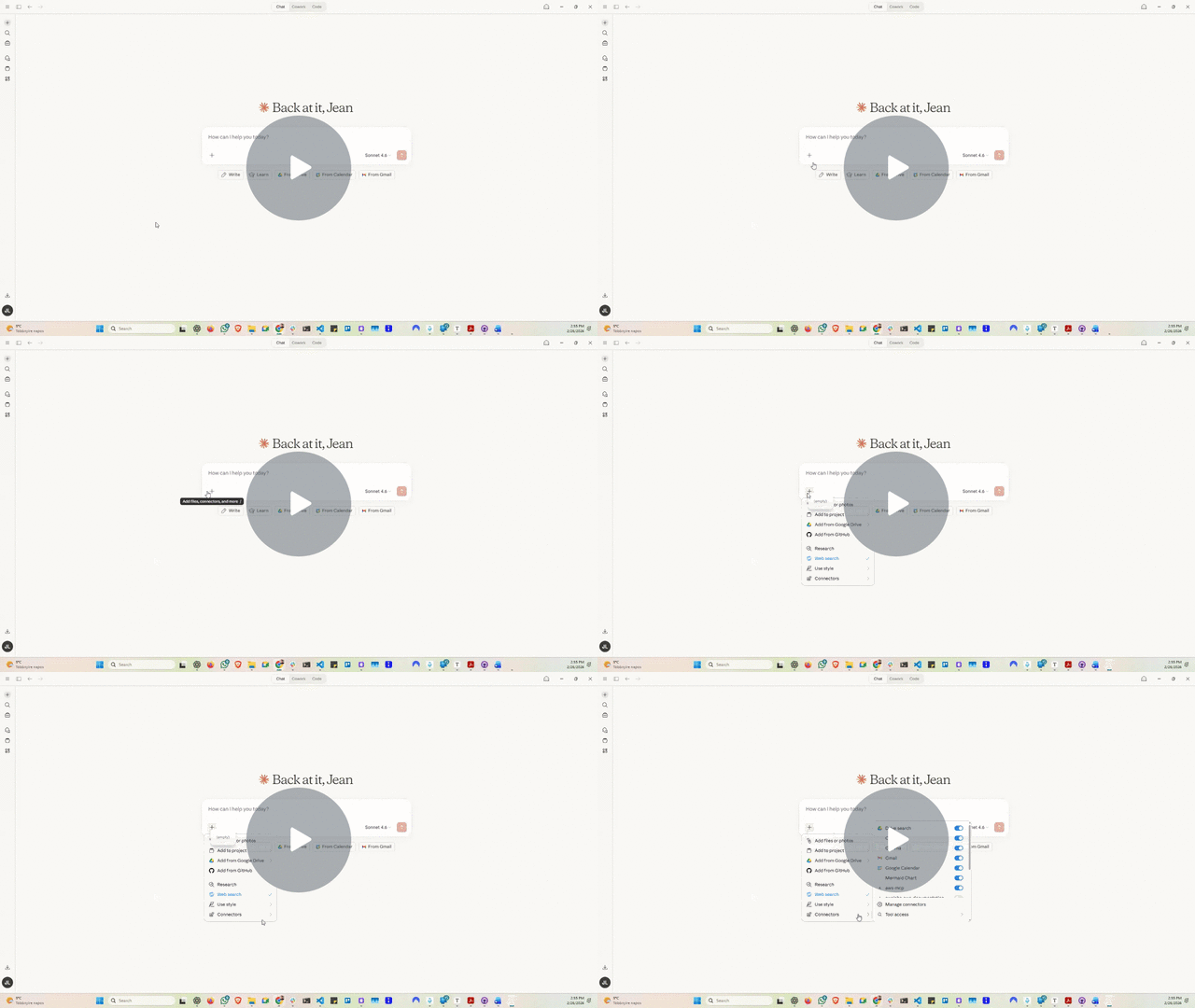
Download the latest release zip, then Settings -> Skills -> Upload zip |
 |
Self-host: ./install.sh --tool chatgpt --grouped (a public Cloud FinOps GPT is on the Roadmap) |
 |
Self-host: ./install.sh --tool gemini (a public Cloud FinOps Gem is on the Roadmap) |
       |
One-liner: curl -sL https://raw.githubusercontent.com/OptimNow/cloud-finops-skills/main/install.sh | bash -s -- --tool <name> |
 |
curl -sL https://raw.githubusercontent.com/OptimNow/cloud-finops-skills/main/install.sh | bash |
 |
pip install cloud-finops-mcp then add to your MCP client config (Claude Code / Cursor / Codex / Windsurf / Cline). Snippets: ./install.sh --tool mcp. Six tools - faceted retrieval over the 28 references and 23 named-pattern playbooks. |
Full options, troubleshooting, and the model-agnostic API loader: see INSTALLATION.md.
A Skill is a structured knowledge file that you attach to an AI agent or a large language model. It gives the model accurate, domain-specific context that it would not otherwise have access to.
Without it, general-purpose LLMs make confident but incorrect statements on FinOps topics. They miscalculate PTU break-even rates. They confuse Azure and AWS reservation mechanics. They give generic advice that ignores how billing actually works on Bedrock or Azure OpenAI. The answers sound plausible. Most of the time, they are wrong on the details that matter.
This skill corrects that by injecting verified, curated FinOps knowledge directly into the model's context - covering billing models, cost allocation patterns, optimisation frameworks, and governance practices across the major cloud providers and AI platforms.
The closest analogy is RAG (Retrieval-Augmented Generation). Like RAG, it extends a model's knowledge beyond its training data. Unlike RAG, it requires no vector database, no embedding pipeline, and no retrieval infrastructure. You copy a folder into your agent setup and the model gains structured expertise on cloud financial management.
This makes it portable: the same skill works with Claude, GPT, Gemini, or any MCP-compatible agent - with no changes to the files.
To keep responses consistent across models, add a response contract to your
system prompt (see INSTALLATION.md, "API integration / Recommended response
contract"). This ensures structured, billing-grounded answers even when model
defaults differ.
- FinOps practitioners building or evaluating AI-assisted cost analysis tools
- Cloud engineers and architects who want a cost-aware assistant integrated into their workflow
- Developers building internal FinOps agents, chatbots, or automation pipelines
- Finance and IT managers evaluating the AI tooling their teams are deploying
No AI infrastructure experience is required to use this skill. If you can copy a folder and follow the installation steps, you can add FinOps expertise to any compatible agent.
- AI cost management is a first-class domain. Most FinOps resources treat AI workloads as an edge case. This skill treats them as a primary concern, with dedicated reference files for each major AI platform.
- Visibility before optimisation. The skill follows a consistent sequence: establish what you are spending, understand what is driving it, then act. It does not recommend optimisation steps before the visibility preconditions are met.
- Provider-mechanics-first, vendor-claim-skeptical. Guidance is grounded in how billing actually works (CUR columns, Azure cost-management semantics, BigQuery export, FOCUS conformance) rather than in vendor marketing or framework positioning. Vendor sustainability and savings claims are read critically, with primary sources cited.
- Maturity is contextual, not aspirational. Verticals where cloud is not a revenue generator do not need to reach Run; Crawl plus selective Walk is the right state when cloud is a cost centre. Verticals where cloud IS the product need Run because cloud efficiency directly drives gross margin. Pushing every organisation toward the same maturity ceiling is malpractice.
- Connect cost to business value. Every recommendation answers the CFO test: what business outcome does this protect or unlock. Cost reduction without a value lens is a leak.
- FinOps is an operating discipline, not a culture. The discipline lives in allocation, anomaly management, commitment management, rightsizing, and governance, all of which produce measurable outputs. "Culture of FinOps" framing tends to substitute slideware for those outputs. In the agentic era this matters more, not less: agents execute discipline, not culture.
These principles will grow into a skills/cloud-finops/doctrine/ directory of opposable
theses with their own primary sources; see the Roadmap section of CLAUDE.md.
The skill provides accurate, framework-aligned guidance across the following domains:
- FinOps for AI - LLM inference economics, token cost management, agentic cost patterns, unit economics for AI features, ROI frameworks, and AI cost governance
- AI value management - AI Investment Council, stage gate model, incremental funding, practice operations, cross-functional governance for AI investments
- GenAI capacity planning - provisioned vs shared capacity, traffic shape analysis, spillover mechanics, throughput units, cross-provider comparison
- Self-hosted vs managed AI inference - decision framework for self-host vs managed LLM, hidden cost surface, ML-Ops maturity rubric, hybrid routing patterns (LiteLLM, Portkey)
- Anthropic billing - Claude model pricing, Fast mode, long-context cliffs, prompt caching, Batch API, governance controls
- AWS Bedrock - model pricing, provisioned throughput, batch inference, cost allocation
- Azure OpenAI Service - PTU pool model, deployment locality, spillover mechanics, model modernisation, optimisation framework, use case economics, cost visibility
- GCP Vertex AI - Gemini pricing, provisioned throughput, batch prediction, cost visibility
- AWS FinOps - CUR setup, Cost Explorer, EC2 rightsizing, Reserved Instances vs Savings Plans, Enterprise Discount Program (EDP) negotiation, RDS cost management, multi-organisation billing, cost allocation, SCPs, and AWS-native quick wins
- Azure FinOps - Azure Cost Management, Reservations, Azure Policy, FinOps Toolkit, Azure Hybrid Benefit, EA-to-MCA transition impact, and Azure-specific optimisation patterns
- GCP FinOps - Compute Engine, Cloud SQL, GCS, BigQuery, networking optimisation
- Tagging governance - tag taxonomy design, naming conventions, IaC enforcement, virtual tagging, MCP-based automation, and compliance monitoring
- FinOps Framework - full FinOps Foundation framework, 22 capabilities, maturity model
- Databricks - cost data foundations (system.billing.usage, DBU executor patterns, DBCU commitments, Photon multiplier, amortised vs PAYG split), cluster and Spark optimisation, Unity Catalog costs
- Microsoft Fabric - F-SKU capacity model, 24-hour CU smoothing, throttling, pause / resume, Reserved Capacity, Pro/PPU to Fabric migration governance trap
- Snowflake - warehouse optimisation, query tuning, QUERY_ATTRIBUTION_HISTORY, Budgets including AI feature budgets, Cortex governance, resource monitor scope
- AI coding tools - Cursor, Claude Code, Copilot, Windsurf, Codex billing models, cost attribution with LiteLLM proxy, seat + usage vs BYOK architecture comparison, optimisation levers, cross-tool spend overlap audit
- OCI - compute, storage, networking optimisation
- SaaS asset management (SAM) - SaaS discovery, license optimization, renewal governance, SaaS Management Platforms (SMPs), shadow IT detection, sprawl patterns, and the connection to AI transition readiness
- ITAM collaboration - FinOps-ITAM joint operating model, BYOL cost mechanics, marketplace channel governance, Tier 1 vendor co-management, consumption-based SaaS overage monitoring, entitlement integration, and maturity framework
- GreenOps and cloud carbon - carbon measurement tooling, FinOps-to-GreenOps integration, carbon-aware workload shifting, region selection, GHG Protocol reporting
- Anomaly management - cost anomaly detection as a standalone Inform-phase capability across AWS / Azure / GCP native tooling, layered detection, masked-anomaly failure mode, integration with Security
- Allocation and showback - FOCUS cost columns (EffectiveCost vs BilledCost), AWS legacy mapping, defensible allocation keys, shared-services hard cases, InvoiceId reconciliation, showback report design
- Chargeback - soft-to-hard chargeback maturity ladder, Finance and accounting prerequisites (ERP readiness, transfer pricing, cross-border tax, SOX-equivalent controls), chargeback-revolt anti-pattern
- Onboarding workloads - migration-time cost hygiene, intake gate, 60-90 day forecast-then-commit rule, double-bubble cost discipline, M&A integration playbook
- Kubernetes FinOps - cross-cluster discipline (EKS / GKE / AKS), OpenCost / Kubecost, FOCUS-emitting K8s allocation, container rightsizing methodology, Karpenter, Spot diversification
- Waste detection playbooks - OptimNow's seven-category waste taxonomy (orphaned, idle, overprovisioned, commitment mismatches, schedule blindness, modernisation, AI/ML inefficiency), two-signal classification, three-tier confidence, WasteLine appliance for AWS
These questions illustrate what this skill is designed to answer accurately. A general-purpose LLM without this skill will produce plausible but unreliable answers to most of them - particularly on billing mechanics, capacity economics, and provider-specific behaviour.
- "We're spending $40K/month on AWS Bedrock and have no idea which features are driving it. Where do we start?"
- "How do I calculate ROI for our AI support bot?"
- "Our inference costs doubled last month - what are the most likely causes?"
- "Should we use Claude Haiku or Sonnet for our classification pipeline?"
- "We have 14 AI projects running across the company and no one knows the total spend. Our CFO wants a governance framework by next quarter."
- "How should we structure an AI Investment Council?"
- "What stage gate model works for AI projects that move faster than our quarterly review cycle?"
- "How do we fund AI experiments incrementally without runaway exposure?"
- "We need to choose between Azure OpenAI PTUs and AWS Bedrock provisioned throughput for a production chatbot doing 500K requests/day."
- "Our traffic is bursty - does provisioned capacity make sense or should we stay on pay-as-you-go?"
- "What's the difference between spillover on Azure vs building failover logic on Bedrock?"
- "How do I calculate the break-even utilisation rate for provisioned throughput?"
- "Should we self-host Llama 4 on rented H100s instead of paying Anthropic per token?"
- "What hidden costs do TCO calculators miss when comparing vLLM on rented GPUs to managed APIs?"
- "Are we mature enough to run our own inference stack? What does that maturity actually require?"
- "How do we design a hybrid stack: self-hosted Qwen3.6 for high-volume RAG, Claude Opus for frontier reasoning?"
- "We're running Claude Sonnet on both AWS Bedrock and the direct Anthropic API. Our monthly bill jumped from $12K to $38K after a developer enabled Fast mode in Claude Code. How do I get this under control and prevent it from happening again?"
- "What's the real cost impact of the 200K input token long-context cliff?"
- "How do prompt caching multipliers work on Anthropic - when do cache writes cost more than they save?"
- "Should we route Claude traffic through Bedrock or use the direct Anthropic API?"
- "How does Bedrock provisioned throughput work and when does it make sense vs on-demand?"
- "What CloudWatch metrics should we monitor for Bedrock cost and performance?"
- "How do we tag and allocate Bedrock costs across teams when per-request tags aren't supported?"
- "What's the batch inference discount on Bedrock and which workloads should use it?"
- "How do PTU reservations work and what are the waste risks?"
- "We reserved 500 PTUs but only deployed 150 - how do we fix this?"
- "Is provisioned capacity on Azure OpenAI actually cheaper than pay-as-you-go for GPT-5?"
- "How does spillover work on Azure OpenAI and how do we monitor the PAYG overflow cost?"
- "What's the cost difference between Gemini Flash and Gemini Pro on Vertex AI for a classification pipeline?"
- "How does provisioned throughput on Vertex AI compare to Bedrock and Azure?"
- "What Cloud Monitoring metrics should we track for Vertex AI cost visibility?"
- "When should we use Vertex AI Batch Prediction instead of on-demand inference?"
- "We have $80K/month in EC2. Should we buy Reserved Instances or Savings Plans?"
- "How do I set up CUR for multi-account cost allocation?"
- "What are the quick wins I should address before any commitment purchase?"
- "We're approaching $2M annual AWS spend - should we negotiate an EDP and what should we watch out for?"
- "Our RDS costs keep climbing - what's the right optimisation sequence?"
- "How do custom billing views work across multiple AWS organisations?"
- "What's the Azure equivalent of AWS CUR?"
- "How do Azure Reservations compare to Azure Savings Plans?"
- "We need to enforce tagging across 15 subscriptions - what's the right approach?"
- "How do we use Azure Hybrid Benefit to reduce our VM costs?"
- "We're migrating from EA to MCA - what FinOps work do we need to do before the switch?"
- "What are the minimum mandatory tags we should require?"
- "How do we enforce tags without blocking deployments?"
- "What's the difference between physical and virtual tagging?"
- "How does OptimNow's MCP for Tagging work?"
- "We need to start reporting our cloud carbon emissions - where do we begin?"
- "How do we pick lower-carbon regions without sacrificing latency?"
- "What's the Carbon Aware SDK and can we use it to shift batch jobs to cleaner time windows?"
- "How do we add carbon tracking to our existing FinOps dashboards?"
cloud-finops-skills/
├── README.md                                   ← This file
├── CLAUDE.md                                   ← Project context for Claude Code and contributors
├── AGENTS.md                                   ← Codex CLI entry point (mirrors CLAUDE.md)
├── llms.txt                                    ← LLM discovery index (cross-agent)
├── INSTALLATION.md                             ← Setup instructions (incl. MCP server)
├── LICENSE.md                                  ← CC BY-SA 4.0
├── install.sh                                  ← Cross-tool installer (12 targets)
├── mcp_server/                                 ← cloud-finops-mcp PyPI package
└── skills/cloud-finops/                               ← Install this folder
    ├── SKILL.md                                ← Entry point + domain router (Claude Code, generic agents)
    ├── POWER.md                                ← Entry point (Kiro IDE)
    ├── references/
    │   ├── optimnow-methodology.md             ← OptimNow reasoning philosophy
    │   ├── finops-for-ai.md                    ← AI cost management
    │   ├── finops-ai-value-management.md       ← AI investment governance
    │   ├── finops-genai-capacity.md            ← GenAI capacity models (cross-provider)
    │   ├── finops-ai-self-hosted-vs-managed.md ← Self-hosted vs managed AI inference decision
    │   ├── finops-anthropic.md                 ← Anthropic billing + governance
    │   ├── finops-aws.md                       ← AWS-specific FinOps
    │   ├── finops-bedrock.md                   ← AWS Bedrock billing
    │   ├── finops-azure.md                     ← Azure-specific FinOps
    │   ├── finops-azure-openai.md              ← Azure OpenAI Service (PTUs)
    │   ├── finops-gcp.md                       ← GCP-specific FinOps
    │   ├── finops-vertexai.md                  ← GCP Vertex AI billing
    │   ├── finops-tagging.md                   ← Tagging and naming governance
    │   ├── finops-framework.md                 ← Full FinOps Foundation framework
    │   ├── finops-databricks.md                ← Databricks allocation, governance, and optimisation
    │   ├── finops-fabric.md                    ← Microsoft Fabric capacity FinOps
    │   ├── finops-snowflake.md                 ← Snowflake optimisation
    │   ├── finops-ai-dev-tools.md             ← AI coding tools (Cursor, Claude Code, etc.)
    │   ├── finops-oci.md                       ← OCI optimisation
    │   ├── finops-sam.md                       ← SaaS asset management (SAM)
    │   ├── finops-itam.md                     ← ITAM collaboration (BYOL, marketplace, entitlements)
    │   ├── greenops-cloud-carbon.md            ← GreenOps and cloud carbon
    │   ├── finops-anomaly-management.md        ← Anomaly management (standalone Inform-phase capability)
    │   ├── finops-allocation-showback.md       ← Cost allocation methodology + showback
    │   ├── finops-chargeback.md                ← Chargeback maturity ladder + Finance/accounting prerequisites
    │   ├── finops-onboarding-workloads.md      ← Migration-time cost hygiene + M&A integration
    │   ├── finops-kubernetes.md                ← Kubernetes cross-cluster discipline (EKS/GKE/AKS)
    │   └── finops-waste-detection-playbooks.md ← Seven-category waste taxonomy + WasteLine
    └── playbooks/                              ← 23 RAG-friendly named-pattern runbooks (~2-4 KB each)
The SKILL.md file is the entry point for Claude Code and generic agents. POWER.md is
the entry point for Kiro IDE. Both route queries to the same reference files - the
domain-specific content is shared.
The "Install in 5 seconds" table at the top of this README covers the one-step path for every supported tool. For per-tool blocks, troubleshooting, the model-agnostic API loader, and the recommended response contract, see INSTALLATION.md.
A version-tagged release zip (cloud-finops-vX.Y.Z.zip) is attached to every
GitHub release for
Claude Desktop / claude.ai users who prefer downloading over building locally.
For agents that want tool-style retrieval rather than full-context injection, the
skill is also published as an MCP server (cloud-finops-mcp on PyPI):
pip install cloud-finops-mcp
./install.sh --tool mcp     # prints config snippets for every MCP-aware client
Six tools across two surfaces. References (long-form provider/discipline files):
list_references, get_reference, find_references (faceted by FinOps
Capability/Phase). Playbooks (small named-pattern runbooks): list_playbooks,
get_playbook, find_playbooks (faceted by scope / service / waste category /
confidence). Wires into Claude Code, Cursor, Codex CLI, Windsurf, Cline, and any
other MCP-aware client. See mcp_server/ and the
INSTALLATION.md MCP section.
This is a living repository. Reference files are refreshed monthly (around the 1st of each month), driven by an automated scan of 29 data sources - cloud provider pricing pages, release notes, billing changelogs, and FinOps community publications. Changes are reviewed before being applied, so the content reflects verified updates rather than raw feed output.
AI cost management is moving particularly fast - new model releases, capacity options, and billing mechanics appear every few weeks. Watch or star this repo to be notified when updates are published.
Process and credit. Open an issue first for anything larger than a typo or
single fact correction, so we can scope before you write. Pull requests should
keep the existing structure of the file you are touching, follow the conventions
in CLAUDE.md (FCP frontmatter, no em dashes, British spelling
in prose, license footer), and pass the FCP coverage check
(./scripts/fcp-coverage.sh --check).
You keep authorship: every contribution lives in the commit history under your
name and shows up in git blame. Substantive contributors are visible in the
repo's contributors list on GitHub.
License and what that means for you. All contributions are licensed under CC BY-SA 4.0. This is an OptimNow-maintained repo, but CC BY-SA was chosen specifically so anyone - including you - can fork, customise, and redistribute under their own brand, as long as they credit and share-alike. If you want a project under your own name rather than contributing here, fork freely; see "Adapting this skill for your organisation" below for the fork playbook. Both paths are first-class.
Practitioner experience is the highest-value contribution. Frameworks and vendor docs are already public; what is rare is "we tried X in production, this is what actually billed". Issues and PRs that bring that lens are welcome in any of the layers below.
Concrete contribution types we actively want:
- Pricing or billing-mechanic correction. A CUR column name we got wrong, a CUD / Reservation discount depth that has shifted, a refund cap that does not match the latest contract terms. Cite the primary source (provider doc, your invoice, an enrollment agreement) so the change is verifiable.
- New named playbook. A waste pattern you see in the field that is not yet in
skills/cloud-finops/playbooks/. Follow the format documented inplaybooks/README.md: symptoms / detection query / fix / anti-pattern / sources, ~2-4 KB. Examples we'd love: Lambda cold-start sprawl, Bedrock model proliferation, Snowflake warehouse fragmentation, Databricks all-purpose-cluster default-on, Cloud Run min-instance creep. - Fix or enrich an existing playbook. A detection query that returns false positives in your data, an anti-pattern you saw burn a team, a fix step that does not work without a precondition we missed.
- Pick up a deferred reference file. The
Roadmap > Deferred reference filessection ofCLAUDE.mdlists the P2/P3 items (forecasting, unit economics, practice operations, education & enablement, benchmarking, cost warehouse) with the rationale and trigger to revisit. If your engagement has surfaced one of those, that is the trigger - open an issue with the engagement context and we will scope the file together. - Tool installer addition. Adding
--tool <new-tool>for a coding assistant or agent we do not yet support. Match the existing installer pattern ininstall.sh(idempotent, dry-run-safe, exclude local-only files like.claude/and.backups/). - Real-world case study or counter-example. Something you tried that did not work, or worked under conditions we do not flag. These end up as anti-pattern blocks in the relevant reference or playbook.
- Adversarial review. Disagreement on a recommendation, with reasoning and ideally a source. The repo is opinionated; it should also be falsifiable.
- Bug report. Installer fails on your setup, a file does not render in your tool, a guard rail false-positives. Open an issue with the exact command and output.
- Translation. Selected references in another language, maintained as a parallel directory rather than a fork, when you can commit to keeping them in sync with the next refresh.
What we push back on:
- Vendor marketing material restated as fact, without a primary source or practitioner-grade evidence behind the claim.
- Wholesale AI-generated reference content with no human practitioner pass.
The pipeline that powers the monthly refresh has hard guard rails (see
the
Lessons learnedsection ofCLAUDE.mdfor why). Hand-written contributions go through human review for the same reasons. - "Best practices" lists with no business-value framing. Every recommendation in this repo connects cost to a business outcome; contributions should follow that pattern.
Fork this repository and customise the reference files for your organisation's context: your cloud stack, your internal policies, your tag taxonomy, your preferred methodology.
A fork gives you a stable base that you can pull upstream updates into at your own pace, without overwriting your customisations. Typical customisations include:
- Adding organisation-specific tag requirements to
finops-tagging.md - Replacing generic pricing examples with your negotiated rates
- Adding reference files for internal tools or platforms not covered here
- Adjusting the methodology file to reflect your team's own approach
OptimNow is a boutique FinOps consultancy helping organisations connect cloud and AI spend to measurable business value. Based in France with European reach.
- Website: optimnow.io
- LinkedIn: OptimNow
- GitHub: github.com/OptimNow
Open-source tools built by OptimNow:
This skill incorporates content derived from the following sources:
- FinOps Foundation - framework definitions, capability descriptions, and maturity model structure are based on the FinOps Framework.
- Point Five - cloud optimisation recommendations informed several provider-specific best practices and quick-win patterns.
All referenced content has been adapted with additional context from OptimNow's consulting delivery experience. Any errors or opinionated interpretations are our own.
This skill is independently maintained and is not affiliated with or endorsed by the FinOps Foundation.
Licensed under CC BY-SA 4.0. See LICENSE.md.
You are free to use, adapt, and redistribute this skill - including for commercial purposes - as long as you credit OptimNow and share any derivatives under the same license.