QoderWake: Your always-on AI Employee

desc: To add a type of AI employee to organizations that is production-ready, secure, controllable, and continuously evolving.
category: Product
img: https://img.alicdn.com/imgextra/i3/O1CN01LyGkWI1e2PKuC4OWH_!!6000000003813-2-tps-1712-1152.png
time: April 30, 2026 · 3min read
Today, a new member joins the Qoder family: QoderWake. It is now officially available for invitational preview.
AI lets one person handle the end-to-end work that previously required a small team. "Super individuals" have shifted from a topic to an executable operational reality. Cases of one-person armies are increasing. At the organization level, small closed-loop teams replace large departments. AI employees join teams. The "communication is execution" collaboration pattern is creating a group of "super organizations". Both trends point to the same gap. Organizations need schedulable AI employees with borders. These employees must work with humans long-term to connect individual capabilities with organization collaboration.
What QoderWake aims to do is fill this gap: to add a type of AI employee to organizations that is production-ready, secure, controllable, and continuously evolving.
QoderWake is your next AI employees. Always Awake. Always Working.
A QoderWake digital employee consists of five layers. These are identity, memory, skills, division of labor, and permission red lines. Identity defines who the employee is. Memory saves long-term context. Skills determine which tools the employee can invoke. Division of labor determines how to split complex Jobs. Permission red lines dictate which tasks require your approval.
The relationship between you and the employee is employer-employee. You name the employee, assign the role, and draw red lines. If you change devices, LLM engines, or workstations, the employee remains the same and follows you. A plain text personality profile acts as the ID card. You can view, Edit, and manage this profile using Git. After the subscription period ends, the training Results do not disappear.
The underlying design separates the employee from the workstation. The employee saves the identity, memory, skills, and permissions. The workstation provides the Run environment. This environment can be a local computer or a cloud sandbox. If the environment changes or restarts, the employee continues the previous work. During the invitational preview, each digital employee stays on your device by default. You decide whether to upload the Code or memory to the cloud.
The ID key, memory summary, Task Queue, and each report remain. You can view, manage, and take over them at any time.
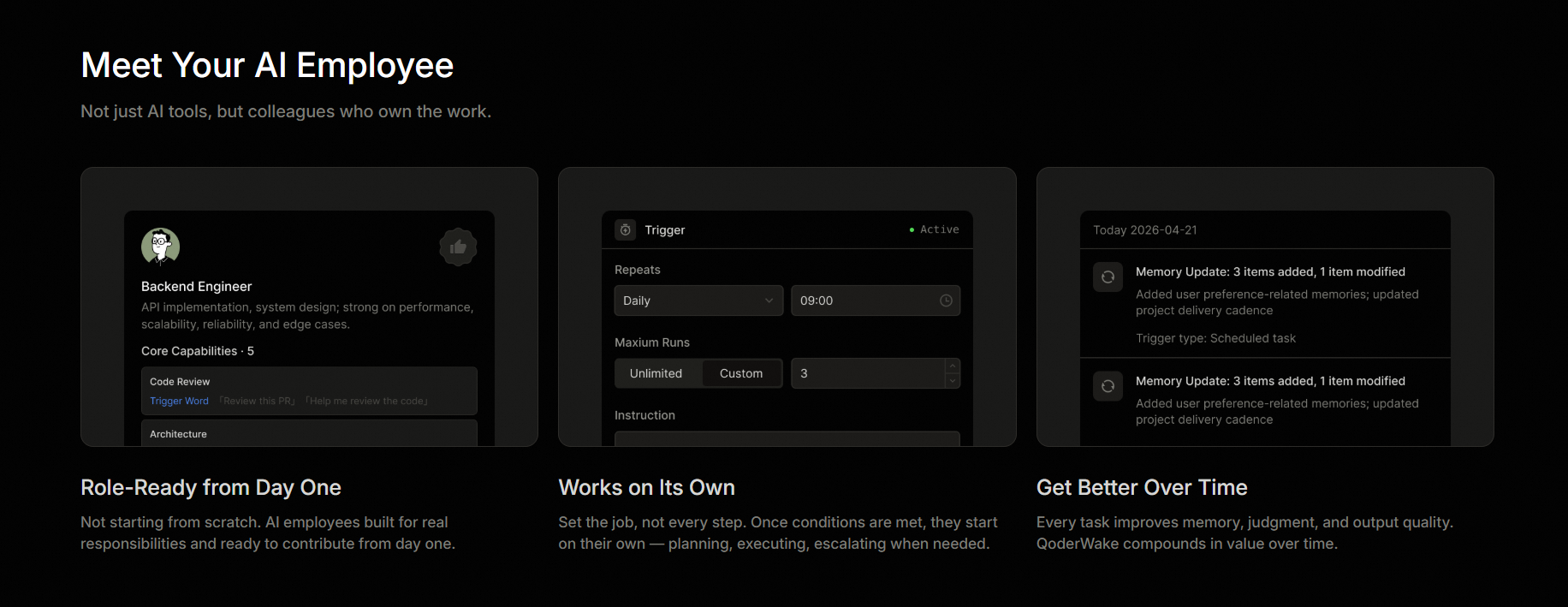
Take digital programmers as an example. This job is naturally suited as a training sample. The Job borders are clear. The Results are verifiable. The tasks occur continuously. They directly Impact delivery efficiency, System stability, and engineering quality. After onboarding, this employee handles four classes of work first. When the Code has Updates, the employee checks the impact scope first. Then, the employee prepares a Change brief for you. The employee connects the scattered Change information for you. When an error occurs, the employee performs a Diagnosis first. The employee prepares an initial Diagnosis report. This report includes what the error is, why it happened, and how to fix it. When an alerting goes off, the employee performs triage first. The employee determines the critical level, possible root causes, and whether to escalate the issue to humans. When the backlog piles up, the employee organizes it first. The employee sorts the Priorities, impact scopes, and suggested actions. The employee signs each output to help you trace back.
Here is a more complete example. A service reports an error at night. The employee first checks recent commits, reviews the alerting context, and organizes possible causes. Then, the employee provides an initial Diagnosis report and a fix path. If it is a configuration issue within the border, the employee submits fix suggestions based on your rules. If the employee encounters red lines such as mainline Changes, external Notifications, or production Data, the employee stops and asks for instructions. You do not need to be present during the entire procedure. Simply spend a few minutes in the morning reviewing the report and deciding the next step.
Harness engineering challenges for running QoderWake 24/7
QoderWake Harness Engineering implements industry-consensus technical capabilities. These include decoupling orchestration, Job loops, context engineering, feedback verification, Status persistence, crash recovery, and full guardrails. However, this is still not enough for a product that runs 24/7, such as QoderWake.
The real challenge of running 24/7 is capability rot. For example, outdated memory pollutes the context. Skills become outdated or conflict with each other. Learning more causes more confusion and becomes more dangerous. Many single-point self-evolution capabilities in the industry, such as memory Management, skill libraries, trajectory Analysis, and session Insights, remain at the level of records and local accumulation. QoderWake must build a systematic path from execution experience to capability growth while preventing rot.
QoderWake Harness Engineering focuses on solving three challenges based on industry-consensus Harness Engineering capabilities. How to ensure security and controllability at the architecture layer? How to ensure production readiness at the execution layer? How to achieve continuous evolution at the capability layer?
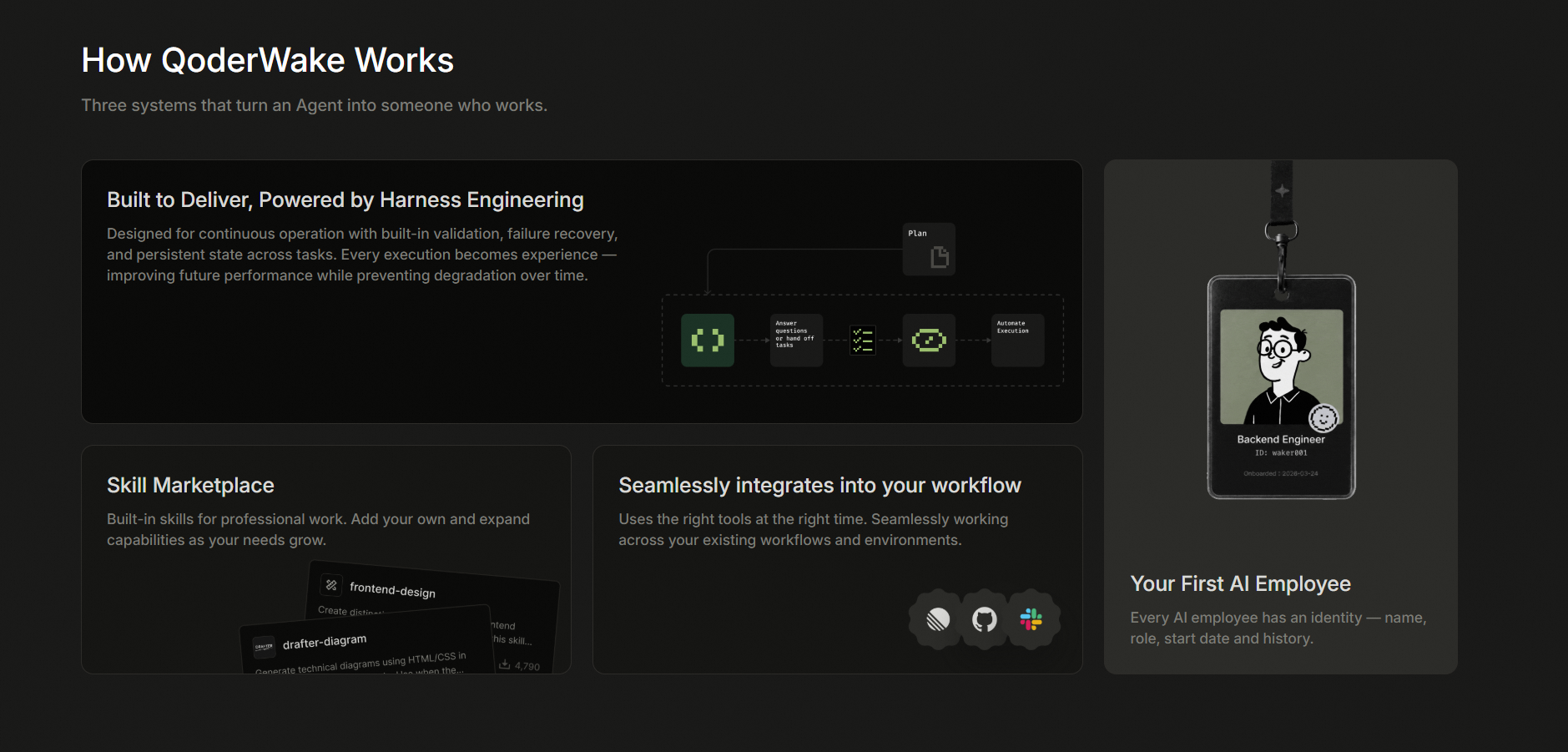
Harness-First architecture: secure and controllable
Separation of duties between certainty and probability. At the decision-making layer, the Orchestrator uses a deterministic flow orchestration mechanism. This ensures that long-term Jobs execute reliably and stably. The model is mainly responsible for intention recognition and inferring. This achieves Brain-Hands-Session decoupling.
Cross-Job persistence of two-layer feedback and failed constraints. At the execute layer, the executor generates and instantly authenticates the results. An independent authenticator (Verifier) reviews the overall Result. If authentication is failed, it triggers a Redo (REWORK). The reason for the failed Result is saved as knowledge. This knowledge serves as priori input for Jobs of the same class in the future.
Session acts as the Unique Status source independent of all widgets. At the reliability layer, all execute management events and Status are stored in the Session layer. If any widget crashes, it can be fully rebuilt based on the Session Status information. This recovers the sequence idempotence.
Execute as experience: active for production
Currently, event logs for steering engineering in the industry are mainly used to recover and audit. QoderWake uses knowledge accumulation and layered memory to treat each execute Result as input for experience accumulation. Each execute operation accumulates production-grade experience.
Distill experience from execute operations. The knowledge engine distills reusable domain experience from specific task execution. For example, consider a failed Code review Job on Day 10. By combining it with previous execute Data, the engine can distill the experience that "a payment module Change must maintain the transaction structure." This experience is not explicitly mentioned in an event-at-a-time.
Automatic Backflow of execute experience. The digital employee experience on Day 1 is the initial baseline. On Day 90, it becomes expert-level experience adapted to individuals and enterprises in depth. Time accumulation becomes part of the product capabilities.
Experience to capability: continuous evolution
Experience accumulation alone is Not Equal To capability growth. Remembering more does not mean doing better. Industry steering engineering optimization mostly focuses on the success rate of a single Job. QoderWake emphasizes a cross-Job, long-term Experience-to-Capability evolution path. It uses three layers to solve "how to learn, what to learn, and how to prevent rot."
Unify multidimensional management events into learnable signals. QoderWake unifies multidimensional management events into structured learnable signals. These management events include dialogs, tool calling, memory retrieval, authentication Results, User corrections, and Redo operations. This provides a complete factual basis for subsequent Attribution and capability accumulation.
Trajectory Attribution performs Attribution based on the complete trajectory. QoderWake performs Attribution based on the complete Job trajectory. It determines whether the experience should be saved as memory, skills, policies, authenticators, or workflows. The accumulation Target is determined by complete trajectory evidence, rather than preset rules.
Anti-rot administration prevents learning confusion. The anti-rot administration (Anti-Rot Governance) mechanism of QoderWake performs monitoring, authentication, demotion, merge, and revoke administration on various long-term capabilities. Outdated memory is eliminated. Conflicting skills are merged or demoted. Invalid policies are revoked. This keeps the memory, skills, workflows, and preferences of AI employees fresh and free from rot.
Invite your AI employee to onboard
Starting today, QoderWake officially opens its invitational preview. We invite users to onboard in batches. We prioritize individuals or teams with clear work scenarios, clear work borders, and real collaboration requirements. To request to join the onboarding list, visit qoder.com/qoderwake.
We are waiting for the first digital employee of your team to start working.