Code for How Hard Can It Be? Hardness-Aware Multi-Objective Unlearning (ICML 2026).
Authors: Jiangwei Chen*, Xinyuan Niu*, Rachael Hwee Ling Sim, Zhengyuan Liu, Nancy F. Chen, Bryan Kian Hsiang Low
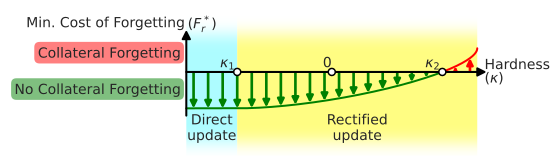
HAMU is a machine unlearning method that quantifies the local hardness of unlearning from the alignment between retain and forget gradients. Instead of optimizing a fixed weighted sum of objectives, HAMU solves a per-step constrained update: improve one unlearning objective by a specified amount while minimizing the cost to the other objective.
HAMU-Q(hamu-q): enforce a minimum improvement in forget quality while minimizing retain utility degradation.HAMU-U(hamu-u): reciprocal variant that prioritizes the retain-side constraint.- Supported tasks: CIFAR-10 vision experiments and WaterDrum-TOFU LLM QA experiments.
- Supported baselines:
ft,ga,gdiff,kl,scrub,gru,pcgrad.
hamu/
  cli/train.py              Unified training and unlearning CLI
  methods/                  HAMU and baseline gradient/update rules
  training/                 Trainer implementations and callbacks
  data/                     Vision and LLM dataset adapters
configs/accelerate/         Default accelerate launch config
scripts/experiments/        Paper experiment launchers
pip install -e .Unlearning has two phases:
- Train or fine-tune an original model on retain and forget data.
- Start from that original model and unlearn with HAMU or a baseline on the retain/forget split.
By default, artifacts are written under artifacts/:
- CIFAR full checkpoints:
artifacts/checkpoints/cifar/seed_<seed>/forget_<class>_<rho>/full - CIFAR retain-only reference checkpoints:
artifacts/checkpoints/cifar/seed_<seed>/forget_<class>_<rho>/retain - WaterDrum-TOFU checkpoints:
artifacts/checkpoints/waterdrum_tofu/seed_<seed>/<subset>/<variant> - Unlearning outputs:
artifacts/results/cifar/andartifacts/results/waterdrum_tofu/ - Dataset cache:
artifacts/dataset_cache/
The experiment scripts enable Weights & Biases by default. Use USE_WANDB=0 for local runs without logging.
Train the full ResNet-20 model:
scripts/experiments/cifar/train_full.sh 42Run HAMU-Q unlearning:
METHOD=hamu-q scripts/experiments/cifar/hamu_unlearn.sh 42Run a baseline:
METHOD=gdiff scripts/experiments/cifar/baseline_unlearn.sh 42Useful overrides:
USE_WANDB=0
FORGET_CLASS=0
HARD_PROBABILITY=0.5
LR=1e-4
CONSTRAINT_RATIO=0.5
NUM_GPUS=1
GRADIENT_PAIRING=sequential
MODEL_NAME=artifacts/checkpoints/cifar/seed_42/forget_0_0.0/full
For parameter sweeps and ablations, see:
scripts/experiments/cifar/rho_sweep.sh
scripts/experiments/cifar/constraint_sweep.sh
scripts/experiments/cifar/full_grad_ablation.sh
scripts/experiments/cifar/stopping_criterion.sh
scripts/experiments/cifar/batch_size_ablation.sh
scripts/experiments/cifar/optimizer_ablation.sh
scripts/experiments/cifar/timing_all.sh
scripts/experiments/cifar/additional_baselines.shTrain the full LoRA-adapted Llama-2 checkpoint:
DATASET_NAME=Glow-AI/WaterDrum-TOFU scripts/experiments/llm/train_full_waterdrum_tofu.sh 42Run HAMU-Q unlearning:
METHOD=hamu-q scripts/experiments/llm/hamu_unlearn_waterdrum_tofu.sh 42Run a baseline:
METHOD=gdiff scripts/experiments/llm/baseline_unlearn_waterdrum_tofu.sh 42Useful overrides:
USE_WANDB=0
FORGET_PCT=10
DUPLICATE_SPLIT=semantic_duplicate
ADD_DUPLICATE=1
LR=1e-4
CONSTRAINT_RATIO=0.5
NUM_GPUS=1
GRADIENT_PAIRING=sequential
MODEL_NAME=artifacts/checkpoints/waterdrum_tofu/seed_42/forget_10/full
For parameter sweeps and ablations, see:
scripts/experiments/llm/semantic_similarity_sweep.sh
scripts/experiments/llm/constraint_sweep.sh
scripts/experiments/llm/full_grad_ablation.sh
scripts/experiments/llm/stopping_criterion.sh
scripts/experiments/llm/batch_size_ablation.sh
scripts/experiments/llm/optimizer_ablation.sh
scripts/experiments/llm/timing_all.sh
scripts/experiments/llm/additional_baselines.shAll scripts call the same CLI:
python -m hamu.cli.train --helpImportant arguments:
--modality {vision,llm}selects the training stack.--unlearning_method nonetrains a normal model.--unlearning_method hamu-qorhamu-uruns HAMU.--unlearning_method ft|ga|gdiff|kl|scrub|gru|pcgradruns a baseline.--model_nameis either a Hugging Face model name or a saved checkpoint.--hamu_constraintsets the per-step HAMU constraint.--use_lr_radiussets the HAMU radius from learning rate and gradient norm.--stop_on_stopping_criterionstops HAMU once the aggregate stopping criterion is met. Without this flag, the criterion is logged only.
HAMU and paired-gradient baselines support two gradient pairing modes:
--gradient_pairing sequential: single-process mode. This computes retain and forget gradients sequentially and currently requires--gradient_accumulation_steps 1.--gradient_pairing split-gpu: parallel mode for an even number of processes. Retain and forget batches are interleaved so alternate processes compute paired gradients in parallel.
split-gpurequires an even process count. For one GPU, setNUM_GPUS=1 GRADIENT_PAIRING=sequential.hamu/methods/core.pycontains compact HAMU and baseline update formulas to compare the methods without reading the trainer code.
@inproceedings{chen2026icml,
  title={How hard can it be? Hardness-aware multi-objective unlearning},
  author={Chen, Jiangwei and Niu, Xinyuan and Sim, Rachael Hwee Ling and Liu, Zhengyuan and Chen, Nancy F. and Low, Bryan Kian Hsiang},
  booktitle={Proc. ICML},
  year={2026}
}