The Arbiter is a multi-agent quality, reasoning, and verification layer for LLM work. It audits the brief, drafts the output, challenges it with specialist critics, compresses the disagreement into a repair brief, verifies the result, and carries forward reusable lessons when the run is worth remembering.


It is built for operators who want more than "send prompt, hope for the best."

Open the full demo GIF directly
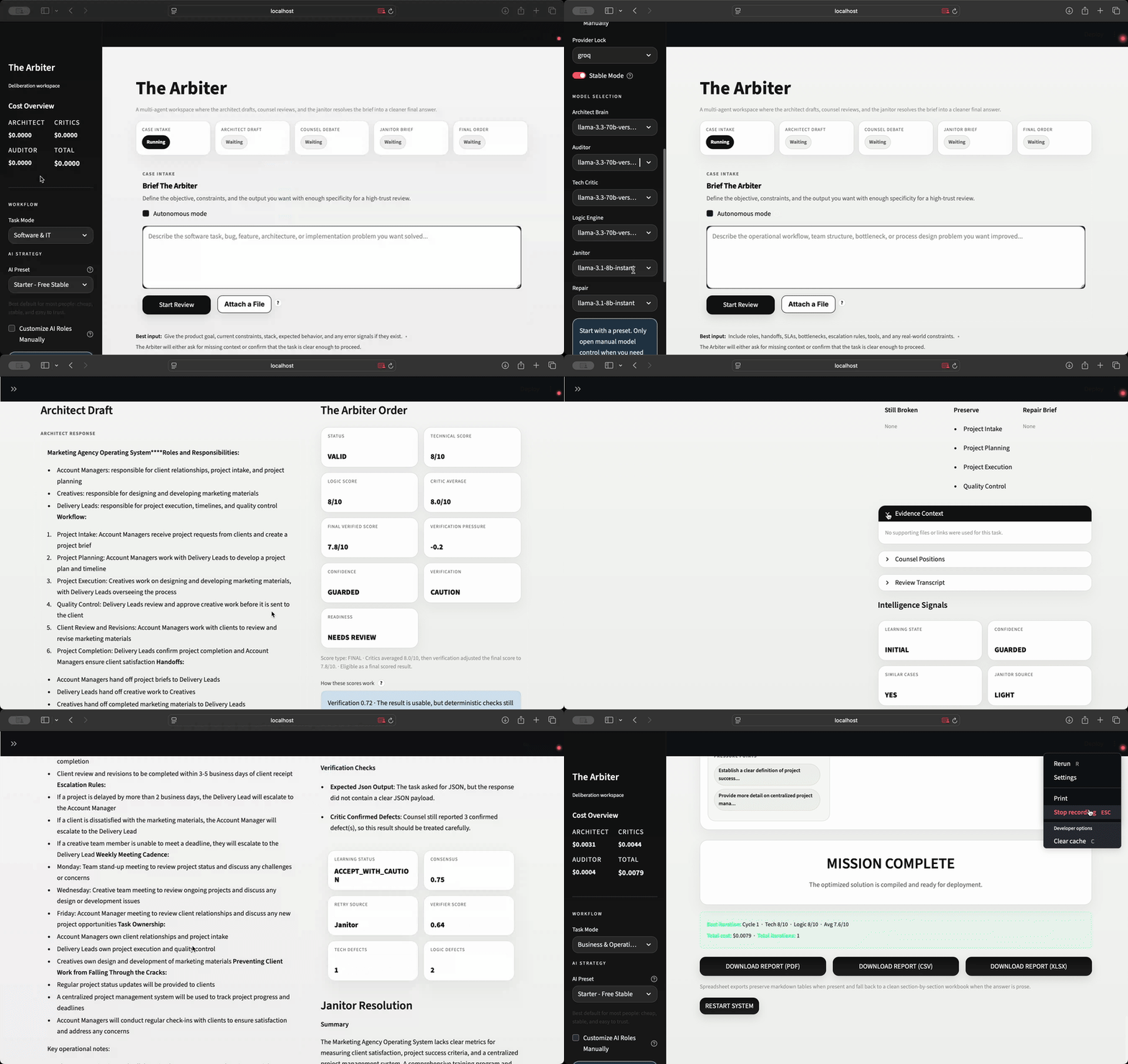
This walkthrough is captured from the real interface during a live local session. Live runs can still take longer than the GIF suggests depending on task complexity, provider availability, rate limits, evidence size, and whether the larger software team path is activated.
The workspace is designed around one job: take a brief, challenge it hard, and make the trust state visible before a user acts on the answer.
What you get in the product today:
- an Auditor that can stop weak briefs before the expensive loop begins
- an Architect path that can expand into a specialist software team for large
Software & ITtasks - a Tech Critic and Logic Critic that score the output from different angles
- a Janitor that repairs against a structured defect brief instead of random retries
- a Final Verifier that can apply deterministic checks, grounding discipline, quote discipline, and software-aware validation
- file, link, and lightweight local RAG support so the system can reason from actual evidence instead of prompt-only context
- export surfaces for
PDF,CSV, andXLSX - an API, analytics dashboard, benchmark runner, and durable memory layer around the loop
Most LLM workflows fail in repeatable ways:
- the brief is too vague
- the first draft is trusted too early
- retries are noisy and expensive
- critic feedback is redundant instead of actionable
- score, trust, and readiness get collapsed into one misleading number
The Arbiter exists to make those failure modes visible and govern them with a structured loop instead of a one-shot answer.
The Arbiter is not trying to be "another chatbot with more buttons." It is trying to be a quality-control system for AI work.
That means:
- trust is separated from style
- verification is separated from critic opinion
- blocked or weak evidence is surfaced instead of hidden
- large software tasks can justify a larger delivery team instead of forcing one generalist answer
- runs leave behind memory, benchmark history, and review telemetry that can be inspected later
flowchart LR
    U["User Brief"] --> A["Auditor"]
    A -->|Approved| R["Architect"]
    A -->|Needs context| C["Clarification"]
    C --> A
    R --> P["Preflight"]
    P -->|Pass| TC["Tech Critic"]
    P -->|Pass| LC["Logic Critic"]
    P -->|Fail| D["Diagnostic Stop"]
    TC --> J["Janitor"]
    LC --> J
    J --> V["Final Verifier"]
    V --> S{"Stop?"}
    S -->|Retry| R
    S -->|Accept| F["Final Result"]
The project now also exposes a service and persistence surface around that loop:
flowchart LR
    UI["Streamlit Workspace"] --> ORCH["Arbiter Orchestrator"]
    API["FastAPI Layer"] --> ORCH
    EVD["Files + Links Evidence Layer"] --> ORCH
    ORCH --> MEM["Native Memory Store"]
    ORCH --> SQL["Optional SQL Persistence"]
    ORCH --> EVAL["Eval Runner"]
    SQL --> AD["Analytics Dashboard"]
More detail lives in docs/architecture.md.
For larger Software & IT tasks, The Arbiter can expand the normal Architect step into a small specialist architecture team instead of relying on one monolithic planning pass.
Why it exists:
- large software tasks often span multiple delivery surfaces at once
- backend, frontend, data, security, and operations concerns can get blurred in a single response
- critics do better when the proposed solution already has clearer subsystem boundaries
When it activates:
- only for
Software & IT - only when the router sees enough complexity signals, such as multi-domain scope, full-stack or production wording, multiple technologies, or a very detailed build brief
Core roles:
Lead Software ArchitectBackend ArchitectFrontend ArchitectDatabase ArchitectDevOps & Reliability Architect
Conditional roles:
Security ArchitectQA/Test ArchitectIntegration ArchitectPerformance Architect
How it works:
- the router decides whether team mode is worth using
- the lead specialist defines the shared delivery blueprint
- the remaining specialists work in parallel when safe
- their structured plans are synthesized into one integrated architecture package
- that package then flows through the normal critics, Janitor, scoring, stopping, and verifier pipeline
How to disable it:
- set
SETTINGS.software_team_enabled = False - or raise
SETTINGS.software_team_min_complexity_score
The Arbiter can now accept supporting materials instead of relying only on the text typed into the prompt box.
Supported evidence inputs:
- local files such as
PDF,DOCX,TXT,MD,JSON,CSV, and code/text documents - web links and reference URLs
How it works:
- the evidence layer extracts readable text from each source
- long sources are chunked into smaller passages
- a lightweight local retrieval pass ranks the most relevant chunks against the user task
- those retrieved excerpts are injected into the task payload as source-grounded context
- the verifier can use attached source names and quoted evidence when judging whether the answer is truly grounded
Why this matters:
- better factual grounding
- better quote and citation behavior
- less dependence on the user pasting long raw context into the prompt
- better transparency about what the model actually used
The Arbiter is not software-only. It currently supports:
Software & ITMarketing & GrowthBusiness & OperationsWriting & ContentPersonal PlanningGeneral Problem Solving
Those modes change:
- auditing emphasis
- architect guidance
- critic weighting
- output expectations
- verifier behavior
That matters because a code task, a GTM brief, and a founder memo should not be judged with the same rubric.
The Arbiter separates quality from confidence.
Critic Averageis the raw weighted view from the Tech Critic and Logic Critic.Final Verified Scoreis the final round score after deterministic verification adjusts the critic average.Verification Statusreports whether the output isVERIFIED,CAUTION,FAILED, orBLOCKED.Readinessreports whether the system believes the result isREADY,CLOSE,NEEDS REVIEW, orBLOCKED.
That means an answer can sound strong, score well with critics, and still be marked cautionary if verification does not clear it.
Clone the repo and create a local environment:
git clone https://github.com/lucaomul/TheArbiter.git
cd TheArbiter
python3 -m venv .venv
source .venv/bin/activate
python -m pip install --upgrade pip
python -m pip install -e ".[dev,api]"
If you want Chroma-backed memory retrieval too:
python -m pip install -e ".[dev,api,chromadb]"Create a .env file with the provider keys you want to use:
OPENAI_API_KEY=...
GROQ_API_KEY=...
GEMINI_API_KEY=...
ANTHROPIC_API_KEY=...
You do not need every provider configured at once.
python -m streamlit run arbiter/app/streamlit_app.pyOpen http://localhost:8501.
The workspace supports:
- optional file attachments
- optional supporting links
- an evidence context panel showing retrieved source chunks and ingestion warnings
- final report export as
PDF,CSV, orXLSX
Spreadsheet export behavior:
- markdown tables are preserved as structured spreadsheet data when present
- prose outputs fall back to a clean narrative workbook with section-aware rows
- export metadata includes task mode, run id, iteration count, and score summary
python -m streamlit run arbiter/app/analytics_dashboard.pypython arbiter/api/run_server.pyOpen http://localhost:8000/docs.
python -m arbiterThis prints the installed version and the main launch commands.
The repo ships with a small Makefile for the core contributor loop:
make install-dev
make lint
make test
make eval-dry-run
If .venv/bin/python exists, those targets use it automatically.
CI runs the same trust-preserving checks on Python 3.10 and 3.11:
ruff check .pytest --tb=shortpython -m evals.runner --dry-run
Submit a run:
curl -X POST http://localhost:8000/api/v1/runs \
  -H "Content-Type: application/json" \
  -d '{
    "user_input": "Write a founder memo about prioritizing reliability before advanced AI features.",
    "task_mode": "Writing & Content",
    "max_iterations": 3,
    "target_score": 8.0,
    "supporting_urls": ["https://example.com/internal-memo"],
    "supporting_materials": [
      {
        "name": "brief.txt",
        "media_type": "text/plain",
        "content": "Use this internal brief as primary evidence.",
        "source_type": "file"
      }
    ]
  }'
List available models:
curl http://localhost:8000/api/v1/modelsAPI routes, auth rules, and example responses are documented in docs/api.md.
The repo now includes an evals/ package with representative fixture tasks across all six task modes.
Dry-run mode is designed for CI and does not call real model providers:
python -m evals.runner --dry-runTo compare the baseline single-model path against the full Arbiter path:
python -m evals.runner --compare --output jsonlImportant honesty note:
- dry-run eval scores are synthetic and operational
- they are useful for regression protection, not for marketing claims
More detail lives in docs/benchmarks.md.
The Arbiter tracks cost as an operational control variable, not as a decorative metric.
Current cost handling combines:
- provider token usage when available
- model-level pricing tables
- conservative fallback estimation when a provider omits usage
- zero-cost cache hits
That makes the numbers directionally useful for product and benchmark work, but they should not be framed as audited billing statements.
The API keeps local development convenient, but it now supports production-safe behavior:
- in local/dev mode, protected routes can be used without an API key
- if
ARBITER_ENV=production, protected routes fail closed whenAPI_KEYis missing or invalid - groundwork is in place for rate-limit headers
Do not commit .env files or provider keys.
The repo is intentionally layered:
- base install: Streamlit workspace and core orchestration
.[api]: FastAPI, SQLAlchemy, Alembic, and related API/persistence pieces.[chromadb]: optional Chroma-backed retrieval.[dev]: test, lint, and contributor tooling
For backwards compatibility, requirements.txt is still present, but contributor work should prefer editable installs through pyproject.toml.
Benchmark and eval history normally writes into .arbiter_memory/benchmark_runs.jsonl.
If that path is blocked or you want to redirect it explicitly, you can set:
ARBITER_BENCHMARK_DIRARBITER_BENCHMARK_PATH
If the primary location is not writable, The Arbiter now falls back to a temp-backed benchmark store and exposes that status in the analytics dashboard.
arbiter/
  agents/      # role implementations
  api/         # FastAPI layer
  app/         # Streamlit workspace + analytics
  config/      # settings, pricing, task profiles
  core/        # orchestration, scoring, stopping, verification
  infra/       # memory, models, DB, registry, logging, LLM client
  models/      # state and result models
  prompts/     # task-mode prompt construction
alembic/       # migration scaffolding
evals/         # benchmark fixtures and runner
tests/         # offline test suite
docs/          # project documentation
The Arbiter is already useful, but it is still evolving.
Current limitations include:
- software verification remains more mature than some non-software validators
- the API and SQL layers are newer than the Streamlit workspace
- long-run benchmark evidence is still growing
- analytics and eval reporting are early product surfaces, not finished BI tools
- cost reporting is increasingly grounded, but still operational rather than invoice-grade
This README is intentionally ambitious about the product direction and intentionally honest about what is still maturing.
Luca Crăciun
- GitHub: lucaomul
- LinkedIn: Luca Crăciun
The Arbiter is being built around a simple conviction:
AI systems should not only generate. They should audit, challenge, repair, verify, and earn trust.