





Unofficial Python package for MOUNTS — Monitoring Unrest From Space. Scrapes SO2 and thermal timeseries from the public MOUNTS pages and exposes them as pandas DataFrames, ready to be written to CSV or XLSX.
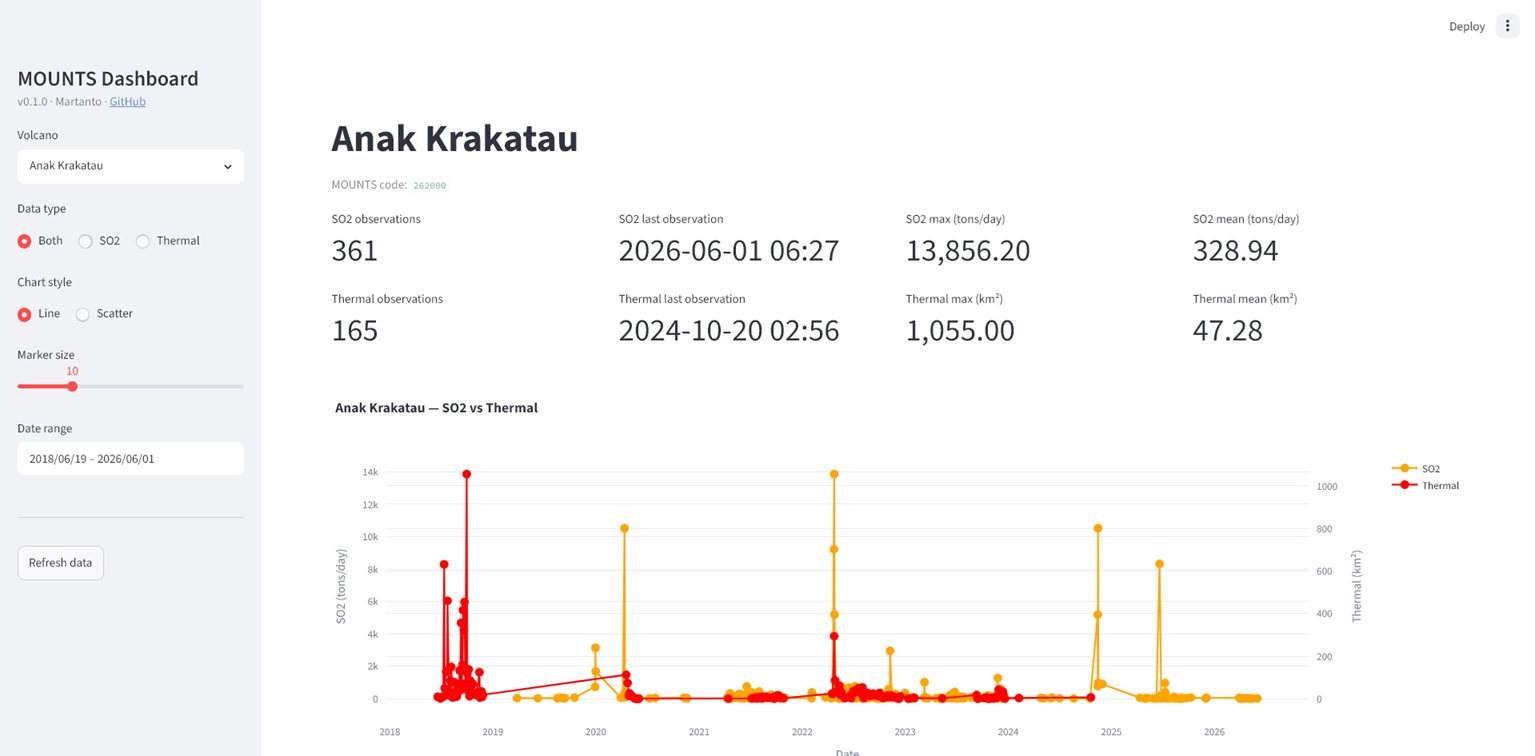 |
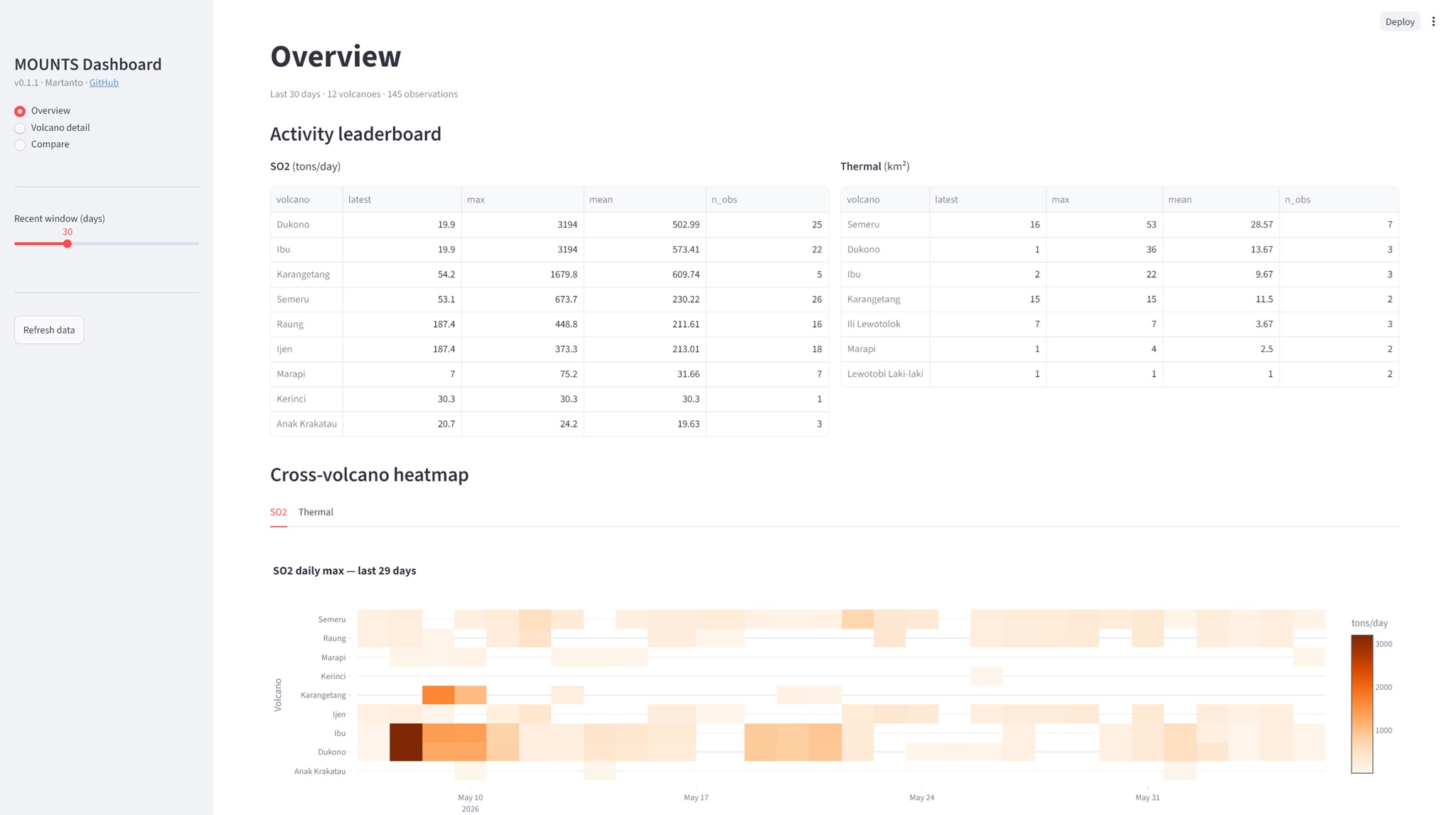 |
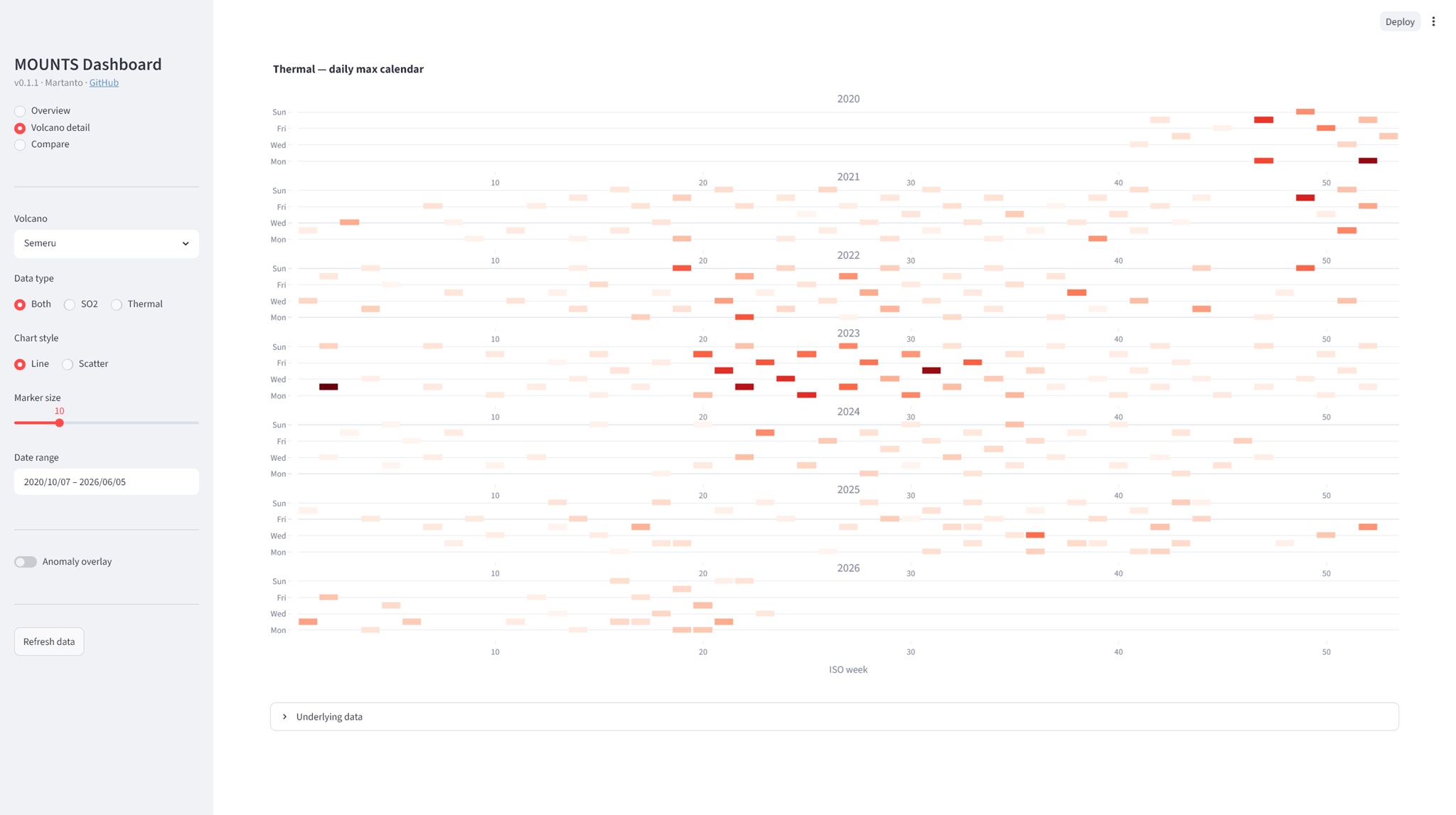 |
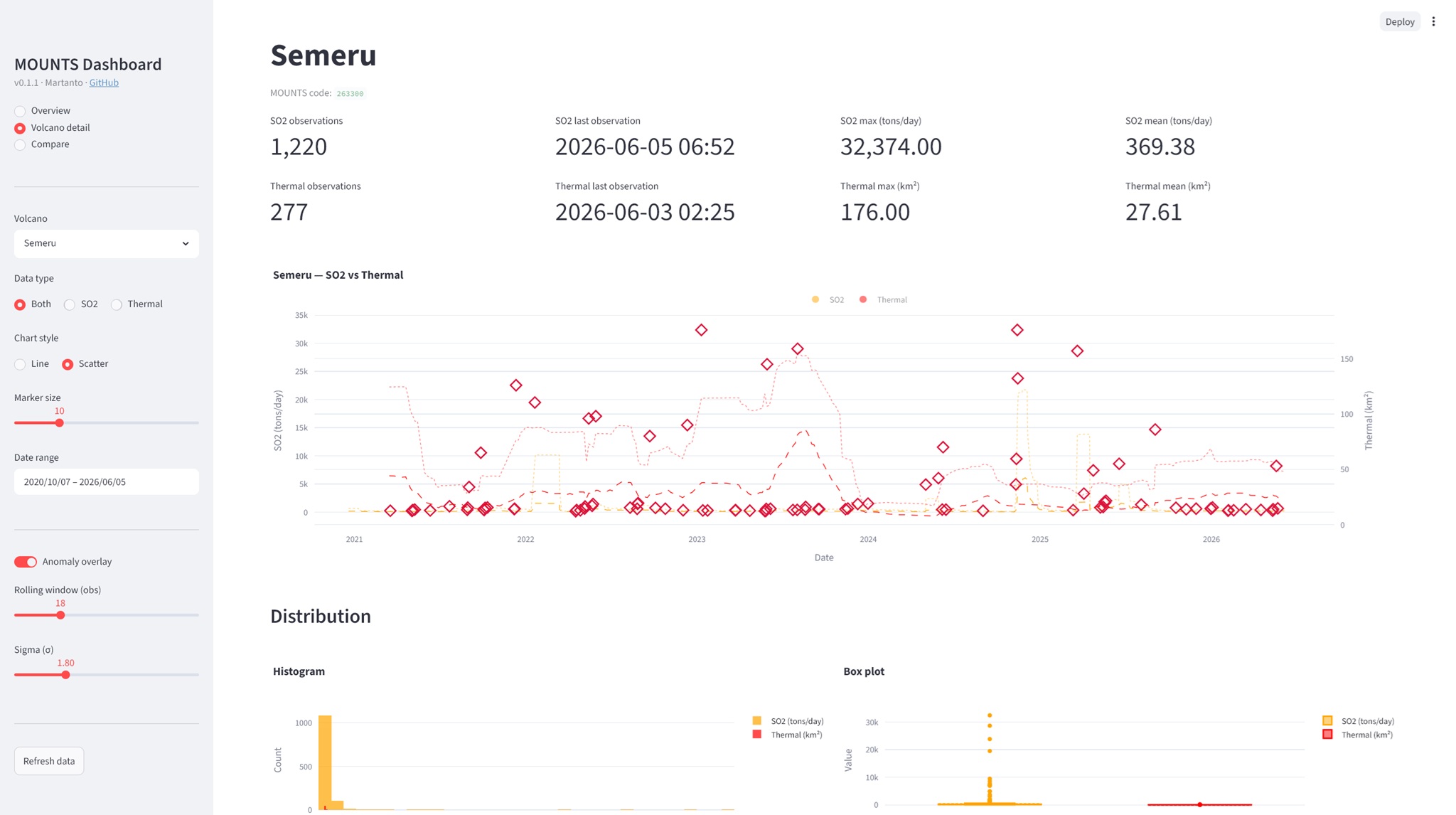 |
 |
 |
This is an unofficial client and is not affiliated with the MOUNTS project. The information presented within the MOUNTS website is provided "as is" and users bear all responsibility and liability for their use of data and images, and for any indirect, incidental or consequential damages arising out of any use of, or inability to use, the data.
- Requirements
- Installation
- Command-line interface
- Dashboard
- Quick Start
- About the project
- Publications
- Credits & Acknowledgements
- Use of the data
- API Reference
- Python
>=3.11 - uv — Python package manager (installation guide)
Install from PyPI:
uv add mounts-project[dashboard]Or with pip:
pip install mounts-project[dashboard]Or install the latest from GitHub:
uv add git+https://github.com/martanto/mounts-projectOr, to work on the source:
git clone https://github.com/martanto/mounts-project
cd mounts-project
uv syncInstalling the package registers a mounts console script:
uv run mounts --help
uv run mounts save --helpExtract every volcano in the default catalog and write the result.
uv run mounts save --type csv                       # → ./output/csv/*.csv + all-volcanoes.csv
uv run mounts save --type xlsx --output-dir data    # → ./data/xlsx/*.xlsx + all-volcanoes.xlsx
uv run mounts save --overwrite -v                   # force re-fetch + verbose logs
uv run mounts save --extract-image --max-workers 16 # also download SO2/thermal images| Option | Default | Description |
|---|---|---|
--type |
csv |
Output format (csv or xlsx). |
--output-dir |
./output |
Override the output directory. |
--overwrite |
off | Re-fetch from MOUNTS even when cached JSON exists. |
--verbose |
off | Emit per-volcano info logs during extraction. |
--extract-image |
off | Also download SO2 and thermal images into <output_dir>/images/. |
--max-workers |
8 |
Thread pool size for image downloads (only used with --extract-image). |
Launch the Streamlit dashboard. Any extra arguments are forwarded to
streamlit run:
uv run mounts dashboard
uv run mounts dashboard --server.port 9000 --server.headless truemounts dashboard opens a Streamlit app that groups the extracted data by
volcano and by data type (SO2 / Thermal). Install the extras first:
uv sync --extra dashboard
uv run mounts dashboard
The dashboard reads output/all-volcanoes.csv from the current working
directory. If it does not exist yet, click Refresh data in the sidebar
or run uv run mounts save --type csv once to populate it.
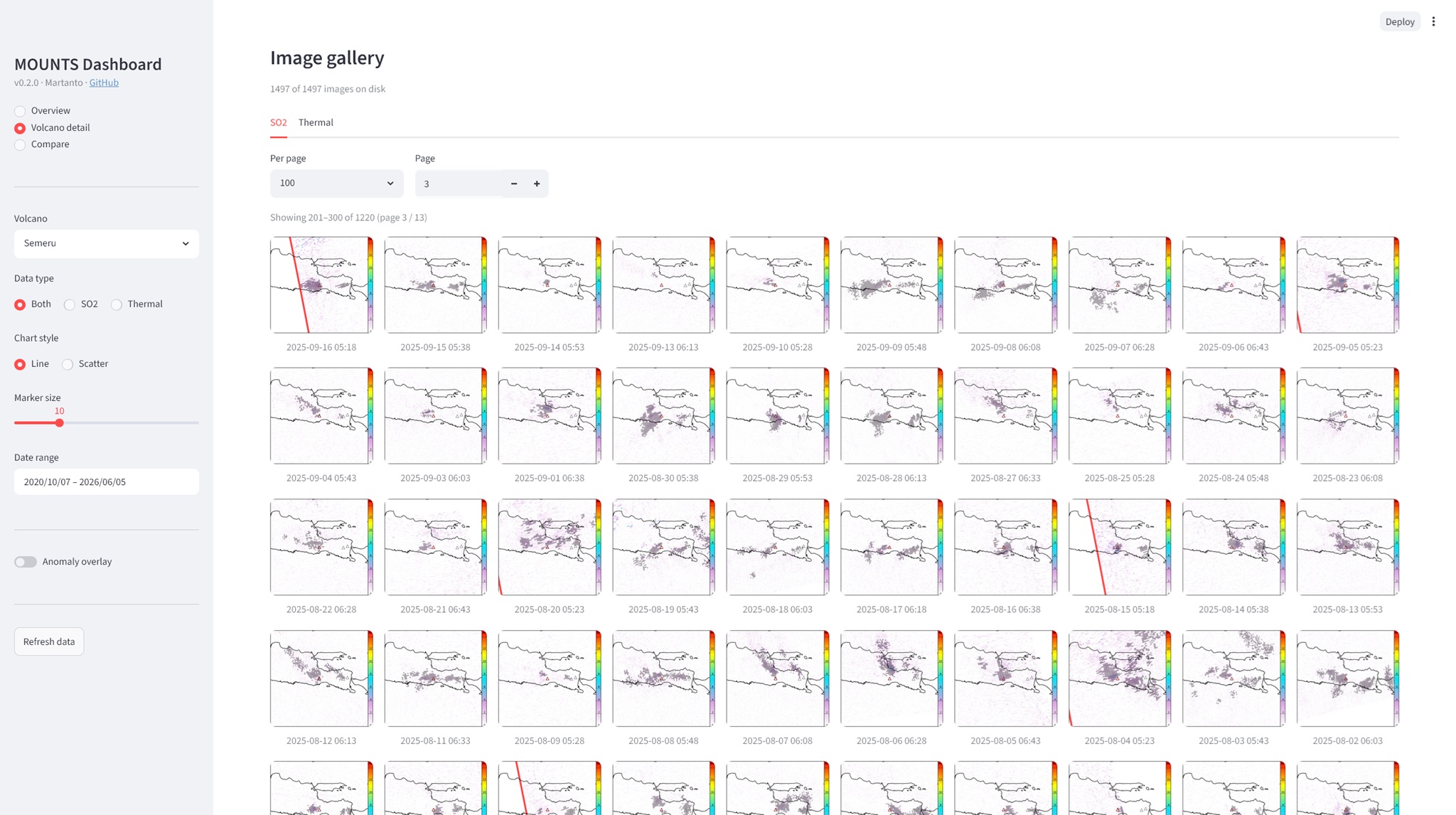
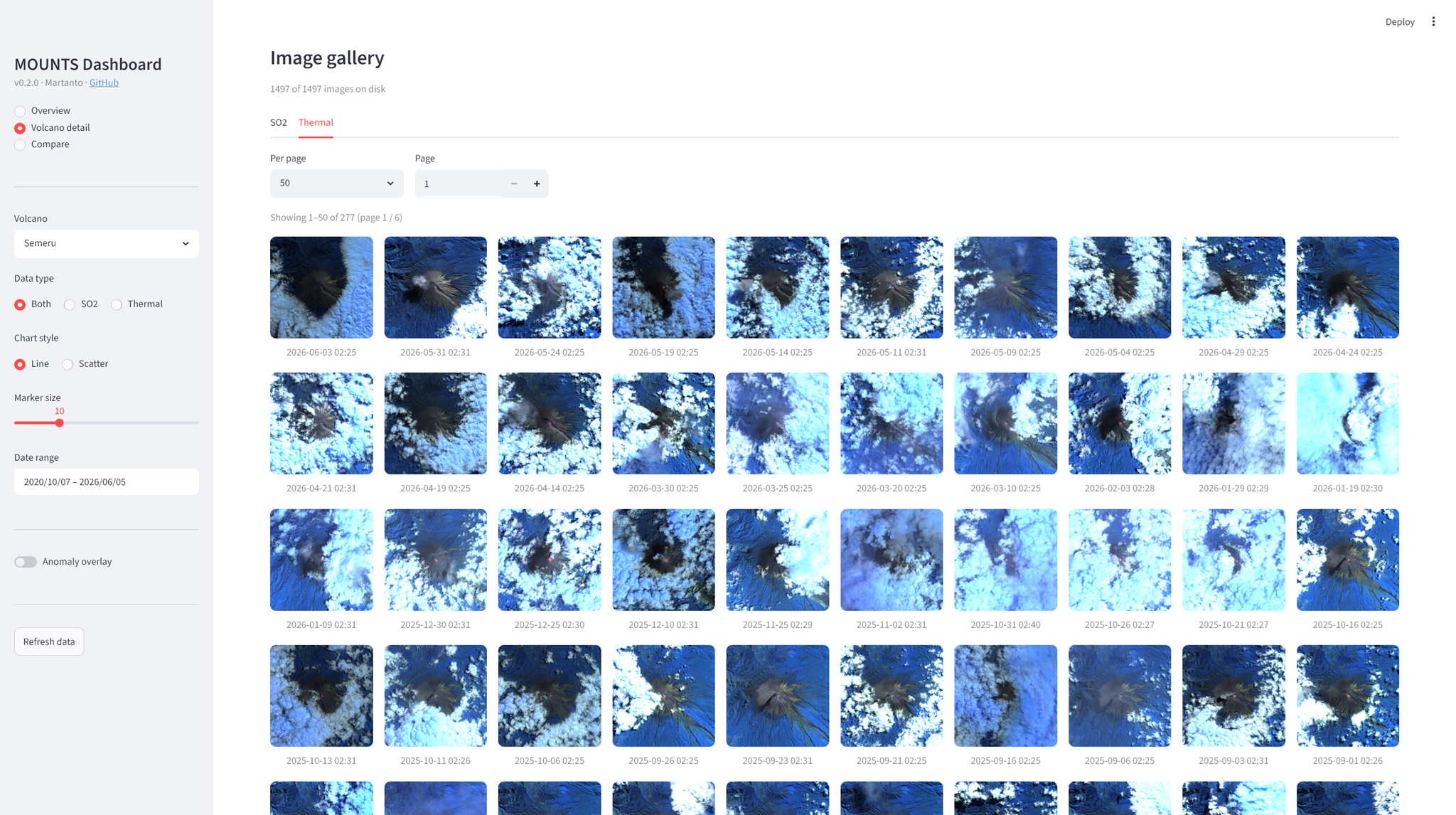
The Volcano detail page also includes an image gallery (since 0.2.1)
showing the SO2 and thermal snapshots previously fetched via
save(extract_image=True). Images live under
output/images/<slug>/{so2,thermal}/ and are matched to the active volcano,
data type, and date range from the existing selectors — no extra index file
is required. The gallery renders as a 10-column grid with a per-tab
Per page dropdown (50 / 100 / 200) and a page selector, both kept in a
narrow control group above the thumbnails.
Minimal example (see main.py):
from mounts_project import MountsProject


def main():
    mounts = MountsProject(verbose=True)

    # Scrape every volcano in the built-in catalog
    mounts.extract()

    # Access the per-volcano DataFrames
    data = mounts.data

    # Export to ./output/xlsx/<volcano>.xlsx + ./output/all-volcanoes.xlsx
    mounts.save(filetype="xlsx")


if __name__ == "__main__":
    main()
Run it:
uv run python main.pyThe full pipeline is chainable:
MountsProject(verbose=True).extract().save(filetype="csv")Outputs land under ./output/:
output/
├── all-volcanoes.csv
├── csv/
│   ├── lewotobi-laki-laki.csv
│   ├── marapi.csv
│   └── ...
└── json/                # cached raw scrape; reused on subsequent runs
    ├── lewotobi-laki-laki-264180.json
    └── ...
To monitor your own list of volcanoes instead of the built-in Indonesian catalog, pass them to
extract():
volcanoes = [
    {"name": "Etna", "code": "211060"},
    {"name": "Stromboli", "code": "211040"},
]
MountsProject().extract(volcanoes=volcanoes).save()
To also download the SO2 and thermal images served by MOUNTS, set extract_image=True
on save(). Images land under <output_dir>/images/<slug>/{so2,thermal}/, and a
figures.json index is written next to the JSON cache by extract():
MountsProject(verbose=True).extract().save(extract_image=True, max_workers=8)MOUNTS is a project conceptualized and led by Sébastien Valade since April 2017. Its aim is to develop an operational monitoring system for volcanoes worldwide using satellite imagery. It currently focuses on processing of Sentinel-1 (SAR), Sentinel-2 (SWIR), and Sentinel-5P (TROPOMI) data. Artificial intelligence "plugins" are developed and implemented in the processing chain to assist monitoring tasks.
The project was from April 2017 to October 2019 funded by GEO.X and carried at TU-Berlin (Computer Vision & Remote Sensing group, Prof. O. Hellwich) and GFZ (Physics of Earthquakes and Volcanoes section, Priv. Doz. T. Walter). Since March 2020, the project is carried at UNAM (Instituto de Geofísica, Mexico City). The server running both the system and website is however still hosted at CV TU-Berlin, with the kind agreement of Prof. Hellwich.
MOUNTS is strongly inspired by the operating MIROVA system, with which tight collaborations are ongoing.
- Valade, S., Ley, A., Massimetti, F., D'Hondt, O., Laiolo, M., Coppola, D., Loibl, D., Hellwich, O., Walter, T.R., Towards Global Volcano Monitoring Using Multisensor Sentinel Missions and Artificial Intelligence: The MOUNTS Monitoring System, Remote Sens., 2019, 11, 1528
- Massimetti, F., Coppola, D., Laiolo, M., Valade, S., Cigolini, C., Ripepe M., Volcanic Hot-Spot Detection Using SENTINEL-2: A Comparison with MODIS–MIROVA Thermal Data Series, Remote Sens., 2020, 12(5), 820
- Davis, T., Jain, V., Ley, A., D'Hondt, O., Valade, S., Hellwich, O., Reference-free despeckling of Synthetic-Aperture Radar images using a deep convolutional network, IGARSS 2020
- Markus, B., Valade, S., Wöllhaf, M., Hellwich, O., Automatic retrieval of volcanic SO2 emission source from TROPOMI products, Front. Earth Sci., 2023, 10
- Valade S., Coppola D., Campion R., Ley A., Boulesteix T., Taquet N., Legrand D., Laiolo M., Walter T. R. and De la Cruz-Reyna S. Lava dome cycles reveal rise and fall of magma column at Popocatépetl volcano, Nature Communications, 2023
- Coppola D., Valade S., Masias P., Laiolo M., Massimetti F., Campus A., Aguilar R., Anccasi R., Apaza F., Ccallata B., Cigolini C., Cruz L. F., Finizola A., Gonzales K., Macedo O., Miranda R., Ortega M., Paxi R., Taipe E., and Valdivia D. Shallow magma convection evidenced by excess degassing and thermal radiation during the dome-forming sabancaya eruption (2012–2020), Bulletin of Volcanology, 2022
- Burgi P.-Y., Valade, S., Coppola D., Boudoire G., Mavonga G., Rufino F., and Tedesco D., Unconventional filling dynamics of a pit crater, EPSL, 2021
- 2017-2019: GEO.X 2-year postdoc fundings for the bottom-up project MOUNTS
- 2019: GEO.X Seed Funding 6-months postdoc for the project MOUNTS-AI dedicated to investigating Artificial Intelligence strategies for volcano monitoring.
- 2021-2023: PAPIIT project IA102221, 2-year project with part of the fundings dedicated to the purchase of new hardware for MOUNTS.
- Andreas Ley developed and trained the convolutional neural network used by MOUNTS to detect ground deformation from Sentinel-1 interferograms.
- Olivier D'Hondt developed the NDSAR toolkit for SAR speckle filtering used in Valade et al. ( 2019).
- Timothy Davis & Vinit Jain, under the supervision of Andreas Ley & Sébastien Valade, developed and trained the convolutional neural network used by MOUNTS to despeckle Sentinel-1 SAR amplitude images: Davis et al. 2020 (IGARSS).
- Manuel Wöllhaf is contributing to the development of the new backend architecture of MOUNTS. He co-supervised Balazs Markus, whose research project focused on the automatic retrieval of volcanic SO2 emission source from TROPOMI products (Markus et al. 2023).
- MIROVA: members of MIROVA developed the algorithm used to detect hot pixels within the Sentinel-2 SWIR bands (Massimetti et al., 2020). MIROVA is a collaborative project between the Universities of Turin and Firenze (Italy). Developments are underway to increase the interactivity between MOUNTS and MIROVA.
- LGS (University of Firenze): many thanks to friends and former colleagues of the Laboratorio di Geofisica Sperimentale (LGS), from whom much was learnt. This website is inspired by the unique interaction of research and monitoring that is achieved in this group.
- Sentinel data are freely available through ESA's Copernicus Open Access Hub, and are partially processed with the free SNAP toolboxes. Earthquake catalogs are provided by GEOFON (GFZ Potsdam) and USGS, and interrogated using the Pyrocko Toolbox.
The products available on the MOUNTS website are value-added products created from freely available Sentinel data provided by ESA. The products are released under the following conditions: permission to freely copy, share and quote for non-commercial purposes, with attribution to MOUNTS and ESA as the original source. If used for academic purposes, contacting Sébastien Valade ( valade@igeofisica.unam.mx) and citing the above-mentioned publication (Valade et al. 2019, Remote Sensing) is kindly appreciated.
Orchestrator that holds the scraped data and drives the
extract() → save() pipeline.
Constructor parameters
| Parameter | Type | Default | Description |
|---|---|---|---|
filter_values |
float | None |
0.1 |
Lower bound applied to the value column after extraction. Rows with value <= filter_values are dropped. None disables filtering. |
output_dir |
str | None |
<cwd>/output |
Root directory for cached JSON and exported CSV/XLSX files. |
overwrite |
bool |
False |
Force re-fetching from MOUNTS even when a cached JSON file exists. |
verbose |
bool |
False |
Emit per-volcano info logs during fetch. |
Attributes
| Attribute | Type | Description |
|---|---|---|
data |
dict[str, pandas.DataFrame] |
Per-volcano DataFrames keyed by volcano name. Populated by extract(). |
catalogs |
list[dict[str, Any]] |
Per-volcano metadata: name, code, updated_at. Populated by extract(). |
figures |
list[dict[str, Any]] |
Per-volcano figure index: name, code, index, so2, thermal image URL lists. Populated by extract(). |
files |
list[str] |
Paths of files written by save(). |
Methods
Fetch timeseries for a list of volcanoes and populate self.data, self.catalogs, and
self.figures. Also writes <output_dir>/figures.json (the figure index used by
download_images_from_json).
| Parameter | Type | Default | Description |
|---|---|---|---|
volcanoes |
list[dict[str, str]] | None |
built-in catalog | List of {"name": ..., "code": ...} entries. When None, uses the bundled 12-volcano Indonesian catalog. |
Returns self for chaining.
Fetch and assemble the combined SO2 + thermal DataFrame for one volcano. Used internally by
extract(); call it directly if you want a single DataFrame without populating self.data.
| Parameter | Type | Description |
|---|---|---|
name |
str |
Volcano name (used for the name column and cache filename). |
code |
str |
MOUNTS volcano code (used in the URL and the code column). |
Returns a DataFrame indexed by datetime, with columns value, graph, type ("SO2" or
"Thermal"), date, time, code, name.
Write per-volcano files plus a merged all-volcanoes export. Calls extract() automatically when
self.data is empty. When extract_image=True, also downloads the SO2 and thermal images
referenced by self.figures after the data files are written.
| Parameter | Type | Default | Description |
|---|---|---|---|
filetype |
Literal["csv", "xlsx"] |
"csv" |
Output format. |
extract_image |
bool |
False |
Also download SO2 and thermal images into <output_dir>/images/<slug>/{so2,thermal}/. |
max_workers |
int |
8 |
Maximum concurrent download threads when extract_image=True. |
Writes:
<output_dir>/<filetype>/<slug>.<filetype>per volcano<output_dir>/all-volcanoes.<filetype>(concatenated)
Returns self for chaining.
From mounts_project.download. All downloaders run in parallel via a
ThreadPoolExecutor that shares a single requests.Session (pooled connections, reused
TLS handshakes). Individual URL failures are logged and skipped so a bad URL does not
abort the batch. URLs are resolved against the MOUNTS static asset host.
| Function | Description |
|---|---|
download_image(image_url, output_dir=None, overwrite=False, verbose=False, session=None) |
Download a single image. Skips re-downloading when the basename already exists unless overwrite=True. |
download_images(image_urls, output_dir=None, overwrite=False, verbose=False, max_workers=8) |
Bulk download a flat list of image URLs into output_dir (defaults to <cwd>/output/images). |
download_images_from_dict(figures_dict, output_dir=None, overwrite=False, verbose=False, max_workers=8) |
For each {"name", "so2", "thermal"} entry, download both image lists into <output_dir>/<slug(name)>/{so2,thermal}/. |
download_images_from_json(figures_json, output_dir=None, overwrite=False, verbose=False, max_workers=8) |
Same as above, but reads the figure list from a JSON file (such as the figures.json written by extract()). |
Standalone use, re-using the figures.json written by a previous extract() call:
from mounts_project.download import download_images_from_json

download_images_from_json(
    "output/figures.json",
    output_dir="output/images",
    verbose=True,
)From mounts_project.utils:
| Function | Description |
|---|---|
get_so2_values(graph_json) |
Extract the SO2 timeseries from a MOUNTS Plotly graph payload (data[2]). Returns a DataFrame with datetime, value, graph, type="SO2". |
get_thermal_values(graph_json) |
Extract the thermal timeseries from a MOUNTS Plotly graph payload (data[0]). Returns a DataFrame with datetime, value, graph, type="Thermal". |
get_json_from_javascript(response) |
Regex-extract and parse the var graph = {...} JavaScript blob from a MOUNTS HTTP response. Raises ValueError if not found. |
slugify(text, hyphen="-") |
Convert arbitrary text into a safe filename slug. |
ensure_dir(path) |
Create a directory (and any missing parents) and return it as a pathlib.Path. |
The package configures loguru on import, writing a console stream
plus daily-rotated logs/mounts_YYYY-MM-DD.log and logs/errors_YYYY-MM-DD.log files in the
current working directory.
From mounts_project.logger:
| Function | Description |
|---|---|
get_logger() |
Return the package-wide loguru logger instance. |
set_log_level(level) |
Change the console log level ("DEBUG", "INFO", "WARNING", "ERROR", "CRITICAL"). |
set_log_directory(log_dir) |
Change where log files are written. |
disable_logging() |
Remove all handlers. |
enable_logging() |
Restore handlers after disable_logging(). |
Set the environment variable DISABLE_LOGGING=1 before import to skip handler setup entirely (
useful for subprocess workers).