
push_swap is an sorting algorithmic project where you must sort a stack of integers using only a limited set of operations and two stacks (a and b).
is to sort a given list of unique integers using a limited set of instructions and only two data structures: stack A and stack B. The primary objective is to achieve the sorted order using the lowest possible number of operations
in case of ERROR the program display error in standerd error
Only these moves are allowed:
-
sa (swap a):Swap the first 2 elements at the top of stack a. -
sb (swap b):Swap the first 2 elements at the top of stack b. -
ss :sa and sb at the same time. -
pa (push a):Take the first element at the top of b and put it at the top of a. -
pb (push b):Take the first element at the top of a and put it at the top of b. -
ra (rotate a):Shift up all elements of stack a by 1. The first element becomes the last one. -
rb (rotate b):Shift up all elements of stack b by 1. The first element becomes the last one. -
rr :ra and rb at the same time. -
rra (reverse rotate a):Shift down all elements of stack a by 1. The last element becomes the first one. -
rrb (reverse rotate b):Shift down all elements of stack b by 1. The last element becomes the first one. -
rrr :rra and rrb at the same time.
At the end, stack b must be empty and all integers must be in stack a, sorted in ascending order.
	git clone <repository-url>
cd push_swapThe project uses a Makefile for building. Simply run:
-> make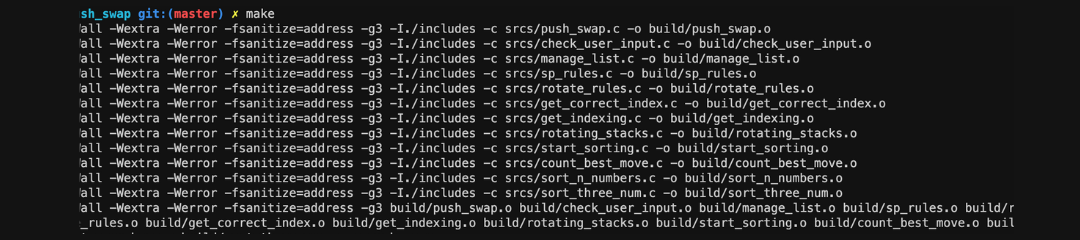
This Create the push_swap executable
./push_swap 3 2 1The output will be a list of instructions (one per line) to sort the input
Example:
./push_swap 30 20 10Output:
ra
sa
I use the best move sorting algorithm to solve this project because I consider it the most efficient approach for this type of problem.
How it works:
The algorithm searches for the number that requires the smallest number of instructions to move, then places it in the correct position in stack B. This process is applied to all numbers in stack A.
Optimization for large datasets:
When the total length of the stack exceeds 400 elements, I leave 50 elements in stack A and sort them using a different algorithm to optimize the total number of instructions. I'll discuss this optimization in detail later.
I work with three main structures in this project:
1. t_stack
This structure holds information about each element and creates a linked list.
typedef struct s_stack
{
    int				idx;
	int				value;
	int				cost_a;
	int				cost_b;
	int				total;
	char			rt_type_a;
	char			rt_type_b;
	struct s_stack	*next;
} t_stack;
2. t_stacks
This structure holds both stacks (A and B), a pointer to the node_cost structure, and the sizes of both stacks.
- Purpose: Pass all necessary data as a single parameter to functions
- Contains: Stack A, Stack B, stack sizes, and cost information
typedef struct s_stacks
{
    t_stack		*ska;
    t_stack		*skb;
    t_node_cost	*node_cost;
    int			skasize;
    int			skbsize;
} t_stacks;
3. t_node_cost
This structure holds information about the best node — the node that requires the smallest number of instructions to be placed in its correct position.
Members:
| Member | Description |
|---|---|
total_cost |
Total number of moves required |
cost_ska |
Number of moves needed in stack A to bring the element to the top |
cost_skb |
Number of moves needed in stack B to position it correctly |
rt_type_a |
Rotation type for stack A: 'r' = rotate, 's' = reverse rotate |
rt_type_b |
Rotation type for stack B: 'r' = rotate, 's' = reverse rotate |
typedef struct s_node_cost
{
	int		total_cost;
	int		cost_ska;
	int		cost_skb;
	char	rt_type_a;
	char	rt_type_b;
} t_node_cost;
Now let's break down the algorithm step by step:
Process:
-
Loop through arguments: Iterate through
argvfrom index1toargc - 1 -
Parse each argument: Loop through each character in
argv[i]until'\0' -
Convert to integer: Pass the string to
atoiwith pointer incrementation -
Custom
atoivalidation:- Skip leading whitespace
- Check for operators (
'-'or'+') - Validate that remaining characters are digits (
'0'to'9') - Skip trailing whitespace
- Return
0(error) if:- Current character is not a digit, operator, or space
- An operator is found and the previous character
*(str - 1)is already a digit - The number exceeds
INT_MAXorINT_MIN
-
Create node: If validation passes, create a new node and add it to the end of the list
-
Continue parsing: The pointer now points after the current number, allowing automatic continuation of validation for the next number in the same argument
Error handling:
If any validation fails, the program:
- Prints
"Error\n"to stderr - Frees all allocated memory
- Returns
0
If the stack is already sorted:
- The program displays nothing
- Returns to the prompt
If the stack is not sorted:
- Proceed to the sorting algorithm
First, I loop through the entire list and convert each value to its corresponding sorted index.
Example:
Input:  50 200 10 95
Output:  1   3  0  2
Explanation:
10is the smallest → index050is the second smallest → index195is the third smallest → index2200is the largest → index3
This means when sorting, the number with index 0 should be placed in position 0, the number with index 1 in position 1, and so on.
now let's start with checking the length of stack if the stack have more than 3 element apply best move algo if the stack len 2 and program enter to this part that mean it's not sorted so swap them to sort the stack and else mean ths stack have 3 element so i sort them by external function that take the bigger element and move them to the end of stack and check first and second element if first > second element swap them so that mean the stack have 3 element sorted in 2 moves in maximum
After index normalization, I determine the sorting strategy based on stack size:
Stack size > 3 elements:
- Apply the best move algorithm (detailed below)
Stack size = 2 elements:
- If the program reaches this point, the stack is unsorted
- Execute
sa(swap) to sort the stack - Result: Sorted in 1 move
Stack size = 3 elements:
- Sort using an optimized 3-element function
- Process:
- Move the largest element to the end of the stack
- Check if the first element > second element
- If true, swap them with
sa
- Result: Stack sorted in maximum 2 moves
I use a variable to determine how many elements to leave in stack A:
- Stack A size < 400: Leave
3elements - Stack A size ≥ 400: Leave
50elements
Why leave elements?
The best move algorithm requires rotating stack B each time to place an element in the correct position. Leaving elements in stack A allows for final optimization:
- 3 elements: Can be sorted in maximum 2 moves
- 50 elements: Can be sorted efficiently after the main algorithm completes
The cost of not optimizing:
When stack A contains more than 400 elements, we would need 100-150 rotations to place each element in the correct position. This adds unnecessary instructions.
Process:
Loop through stack A, moving elements to stack B until the threshold is reached:
-
Update stack sizes:
- Decrement
skasize - Increment
skbsize
- Decrement
-
Calculate rotation costs:
- Use
compute_rot_costs()to calculate the cost of moving each element
- Use
-
Find the best move:
- Use
find_min_move_node()to identify the node with the smallest number of instructions
- Use
-
Execute the move:
- Push the best node from stack A to stack B (
pb)
- Push the best node from stack A to stack B (
The t_node_cost structure holds information about the best node:
- Number of rotations needed for stack A
- Number of rotations needed for stack B
- Rotation type for each stack (
'r'= rotate,'s'= reverse rotate)
Combined rotations:
When both stacks need the same rotation type, I use combined operations (rr or rrr):
Example:
Stack A needs: 13 rotations (rotate)
Stack B needs: 10 rotations (rotate)

Without optimization: 23 total moves (13 × ra + 10 × rb)
With optimization:    13 total moves (10 × rr + 3 × ra)
This optimization reduces unnecessary operations by performing simultaneous rotations.
The bonus part includes a checker program that validates whether the instructions from push_swap correctly sort the stack.
The checker reads the input numbers the same way as push_swap:
- Takes each number as an element in a struct and adds it to a linked list
- Validates the input using the same logic as
check_user_input()in push_swap - Checks for invalid input and duplicates
- On error: Displays
"Error\n"and exits
Buffering process:
- Read instructions from standard input into a buffer
- Read 4 bytes at a time and append to the original buffer
- Validate that the buffer contains only valid instruction characters:
p,a,b,r,s,\n - If invalid character found: Free the buffer and return error
Parsing and executing instructions:
while (tmp && *tmp)
{
    i = 0;
    while (*(tmp + i) && *(tmp + i) != '\n')
        i++;
    if (i > 3)
        return (free(tmp), 0);
    if (!apply_moves(tmp, i, ska, skb))
        return (free(tmp), 0);
    while (*tmp && i-- >= 0)
        tmp++;
}
How it works:
- Loop through the buffer until a newline character
\n - Variable
iholds the length from the current position to the newline (instruction length) - Validate instruction length: If
i > 3, the instruction is invalid → return error - Call
apply_moves(tmp, i, ska, skb)to validate and execute the instruction - Increment the pointer by
ito move to the next instruction
The apply_moves() function uses ft_strncmp(src, dst, len) to match instructions:
if (ft_strncmp("ra\n", instra, len) == 0 || ft_strncmp("ra", instra, len) == 0)
    rotate(ska);
Process:
- Compare the buffer substring with valid instructions (
sa,sb,ss,pa,pb,ra,rb,rr,rra,rrb,rrr) - If match found: Execute the corresponding operation on the stack
- If no match found: Return
0→ Display"Error\n"and exit
Pointer management:
After executing each instruction, increment the pointer by i + 1 (to skip past the newline), making it point to the beginning of the next instruction.
| Result | Output |
|---|---|
| Stack is sorted and stack B is empty | OK |
| Stack is not sorted or stack B is not empty | KO |
| Invalid instruction or invalid input | Error |
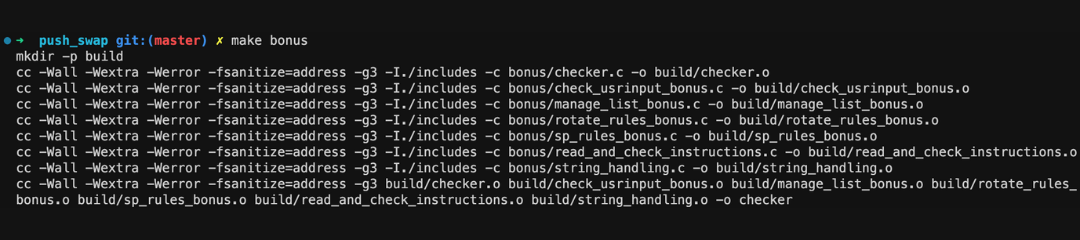
Example usage:
./push_swap 3 2 1 | ./checker 3 2 1
OK
echo -e "sa\npb" | ./checker 3 2 1
KOecho "invalid_instruction" | ./checker 3 2 1
ErrorKey topics I studied:
- Linked Lists
- Sorting Algorithms
Helpful resources:
| Link | Description |
|---|---|
| Sorting Algorithm Comparison | Overview of sorting algorithm types and performance |
| Push Swap Inspiration | Algorithm strategy and implementation |
| Sorting Algorithm Types | Understanding different sorting approaches |
| VisuAlgo - Sorting | Interactive visualization of sorting algorithms (Bubble, Selection, Insertion, Merge, Quick, Heap) |
I did not use AI to learn or implement any part of this project.
AI was only used for documentation purposes:
- Formatting and structuring the README file
- Grammar and spelling corrections
- Improving the visual presentation of the documentation
All code, algorithms, and problem-solving were done independently without AI assistance.